
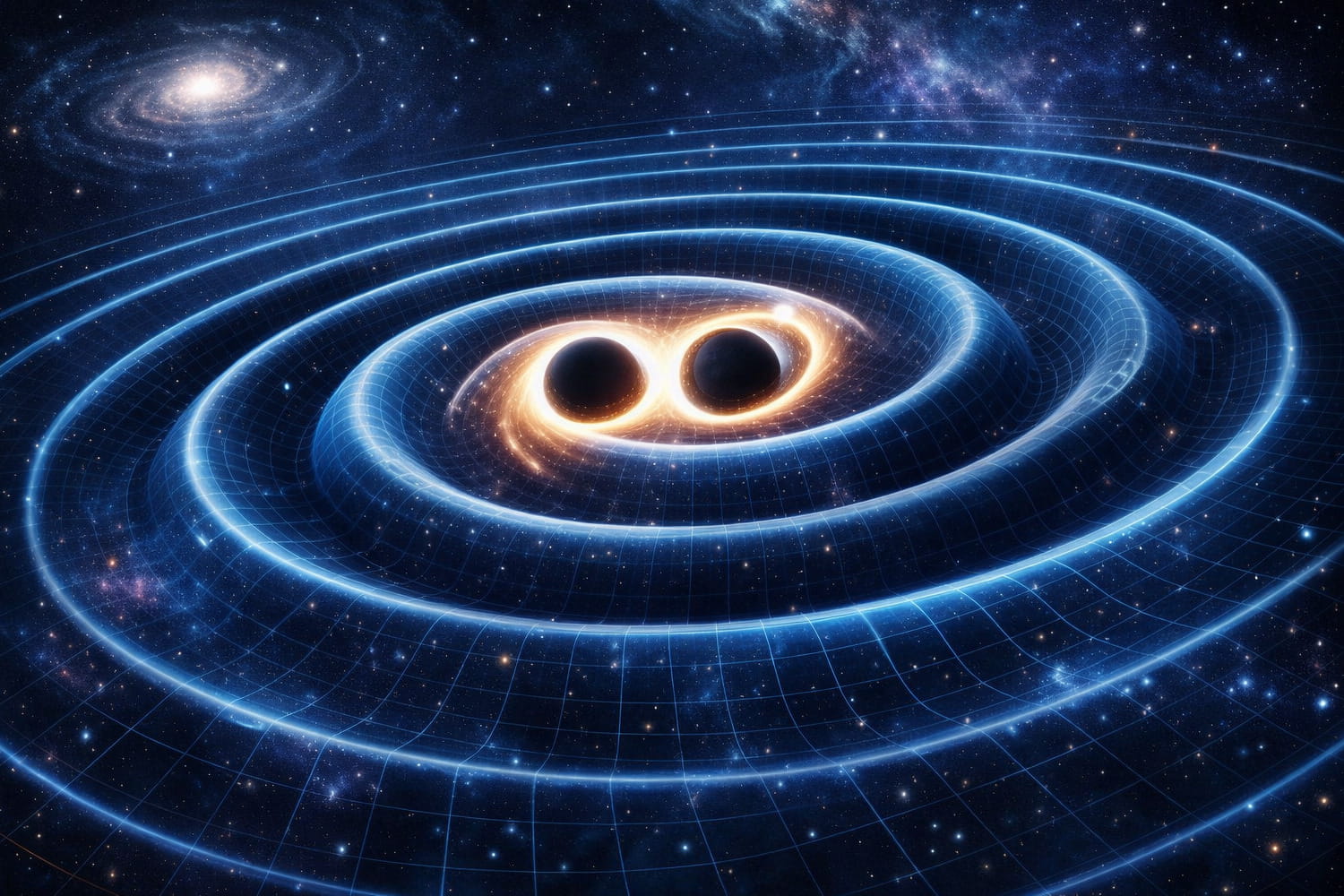
Deep within the cosmos, invisible ripples in the fabric of spacetime travel across the universe carrying information about the most dramatic events in cosmic history. These mysterious signals, predicted a century ago, have now opened an entirely new window for observing the universe beyond traditional light-based astronomy. You might not have known that gravitational waves allow us to literally “hear” collisions of black holes that occurred billions of years ago. These incredible facts about gravitational waves reveal a universe where reality itself vibrates in response to the most violent cosmic cataclysms. Fascinating facts about these phenomena will transform your understanding of how our universe truly operates.
- Albert Einstein predicted the existence of gravitational waves in 1916 as a consequence of his general theory of relativity. He proposed that massive accelerating objects should produce ripples in the structure of spacetime similar to how a stone creates waves on the surface of water. However Einstein himself doubted these waves would ever be detected due to their extraordinary weakness. It took a full century after this prediction before scientists finally succeeded in registering the first gravitational waves.
- The first direct detection of gravitational waves occurred on September 14 2015 by detectors at the LIGO observatory in the United States. This signal designated GW150914 was created by the merger of two black holes with masses of 29 and 36 solar masses approximately 1.3 billion years ago. The spacetime vibrations that reached Earth changed the distance between the detector’s mirrors by less than one thousandth the diameter of a proton. This discovery confirmed the last unverified prediction of Einstein’s general theory of relativity.
- Gravitational waves travel at the speed of light in vacuum which amounts to approximately three hundred thousand kilometers per second. This speed represents a fundamental constant of the universe independent of the source’s mass or its distance from observers. Unlike light gravitational waves interact almost negligibly with matter and can pass through any obstacles without attenuation. This property enables them to carry information from the deepest recesses of space where electromagnetic radiation cannot penetrate.
- Sources of gravitational waves include massive cosmic objects moving with acceleration particularly during catastrophic events. The most powerful signals emerge during mergers of black holes or neutron stars supernova explosions or the rotation of asymmetric pulsars. Even Earth orbiting the Sun generates gravitational waves but their energy is so minuscule that modern instruments cannot register them. Only events involving extreme gravitational fields and enormous masses create waves accessible to current observation technology.
- Gravitational waves possess two fundamental polarizations denoted as plus and cross. When a wave passes through objects it deforms space in perpendicular directions compressing it along one axis while stretching it along another. This deformation is transverse meaning it occurs perpendicular to the wave’s direction of propagation. Modern detectors precisely measure these microscopic changes in distances between objects to register passing gravitational waves.
- Scientists use laser interferometers with arms several kilometers long to detect gravitational waves. The operating principle involves splitting a laser beam that travels along two perpendicular paths to mirrors and then returns to recombine. When a gravitational wave passes through the detector it minutely alters the arm lengths causing a shift in the laser light’s interference pattern. These detectors are extraordinarily sensitive capable of measuring length changes on the order of ten to the minus nineteenth power of a meter.
- The first detection of gravitational waves from merging neutron stars occurred on August 17 2017 marking the dawn of multi-messenger astronomy. Unlike black hole mergers this event was accompanied by a gamma ray burst and an optical afterglow observed by telescopes worldwide. This allowed scientists not only to “hear” the event through gravitational waves but also to “see” it across various electromagnetic spectrum ranges. Such observations confirmed that neutron star mergers serve as cosmic factories for heavy elements like gold and platinum.
- During the first few years of observation the LIGO and Virgo detectors registered dozens of events related to compact object mergers. Most were black hole mergers but scientists also detected neutron star collisions and possible mixed events involving a black hole and a neutron star. Each event provides unique data about masses spins and distances to these exotic objects. This accumulating statistics helps astronomers understand how binary systems with compact objects form and evolve over cosmic time.
- Gravitational waves carry energy away from their source leading to mass loss in the system during the event. During the merger of two black holes up to five percent of their combined mass converts into gravitational wave energy within a fraction of a second. This power briefly exceeds the total radiation output of all stars in the observable universe combined. This energy loss causes the orbits of compact objects to gradually shrink ultimately leading to their final merger.
- The LIGO observatory in the United States consists of two identical detectors located in Washington and Louisiana states more than three thousand kilometers apart. This arrangement allows confirmation of signal authenticity since a genuine gravitational wave should reach both detectors with a slight time difference. The European Virgo detector in Italy and Japan’s KAGRA instrument complement this network improving the precision of source direction determination. International collaboration stands as a crucial factor for success in gravitational wave astronomy.
- The 2017 Nobel Prize in Physics was awarded to Rainer Weiss Barry Barish and Kip Thorne for their decisive contributions to the LIGO detector and the observation of gravitational waves. Rainer Weiss developed the concept of the laser interferometer back in the 1970s while Kip Thorne provided theoretical foundations for detecting waves from astrophysical sources. Barry Barish led the LIGO project transforming it from an experimental idea into a functioning world class observatory. This prize underscored the discovery’s significance for the advancement of fundamental physics.
- The future space observatory LISA scheduled for launch in the 2030s will consist of three spacecraft forming a triangle with sides measuring 2.5 million kilometers each. Unlike ground based detectors LISA will detect gravitational waves at much lower frequencies enabling the study of supermassive black hole mergers in galactic centers. This mission will open a new observational window to the cosmos inaccessible to current instruments. LISA will become the first gravitational wave detector positioned in space.
- Gravitational waves from primordial events in the early universe may have left imprints in the cosmic microwave background radiation. Scientists search for a specific type of polarization in this background radiation that could have been induced by gravitational waves from the universe’s inflationary epoch. Detecting such waves would allow us to peer into the era preceding the formation of the first atoms merely a fraction of a second after the Big Bang. This would provide unique data for testing theories about the origin of our universe.
- Pulsars especially binary systems containing pulsars enable indirect detection of gravitational waves through observation of orbital changes. In 1974 Russell Hulse and Joseph Taylor discovered the first binary pulsar PSR B1913+16 and determined that its orbital period was gradually decreasing precisely as general relativity predicts due to energy loss through gravitational waves. This indirect confirmation of gravitational waves earned them the 1993 Nobel Prize in Physics. These observations continued for over thirty years precisely verifying Einstein’s predictions.
- Gravitational waves differ from electromagnetic waves in that they represent oscillations of spacetime geometry itself rather than oscillations of electric and magnetic fields. They interact with matter far more weakly than light making them practically invisible to conventional telescopes. However this very weak interaction allows them to pass through dense clouds of dust and gas that block electromagnetic radiation. This makes gravitational wave astronomy a unique tool for exploring hidden corners of the universe.
These captivating facts about gravitational waves represent merely the beginning of a new era in astronomy that allows us to perceive the universe not only with our eyes but also through the vibrations of reality itself. Each new detection reveals previously unknown aspects of cosmic processes and tests the boundaries of our physical understanding. Future generations of astronomers will be able to construct a complete map of the gravitational wave sky unveiling mysteries that have remained hidden from humanity for millions of years. Gravitational waves remind us that the universe always finds a way to tell its story to those who know how to listen.


