
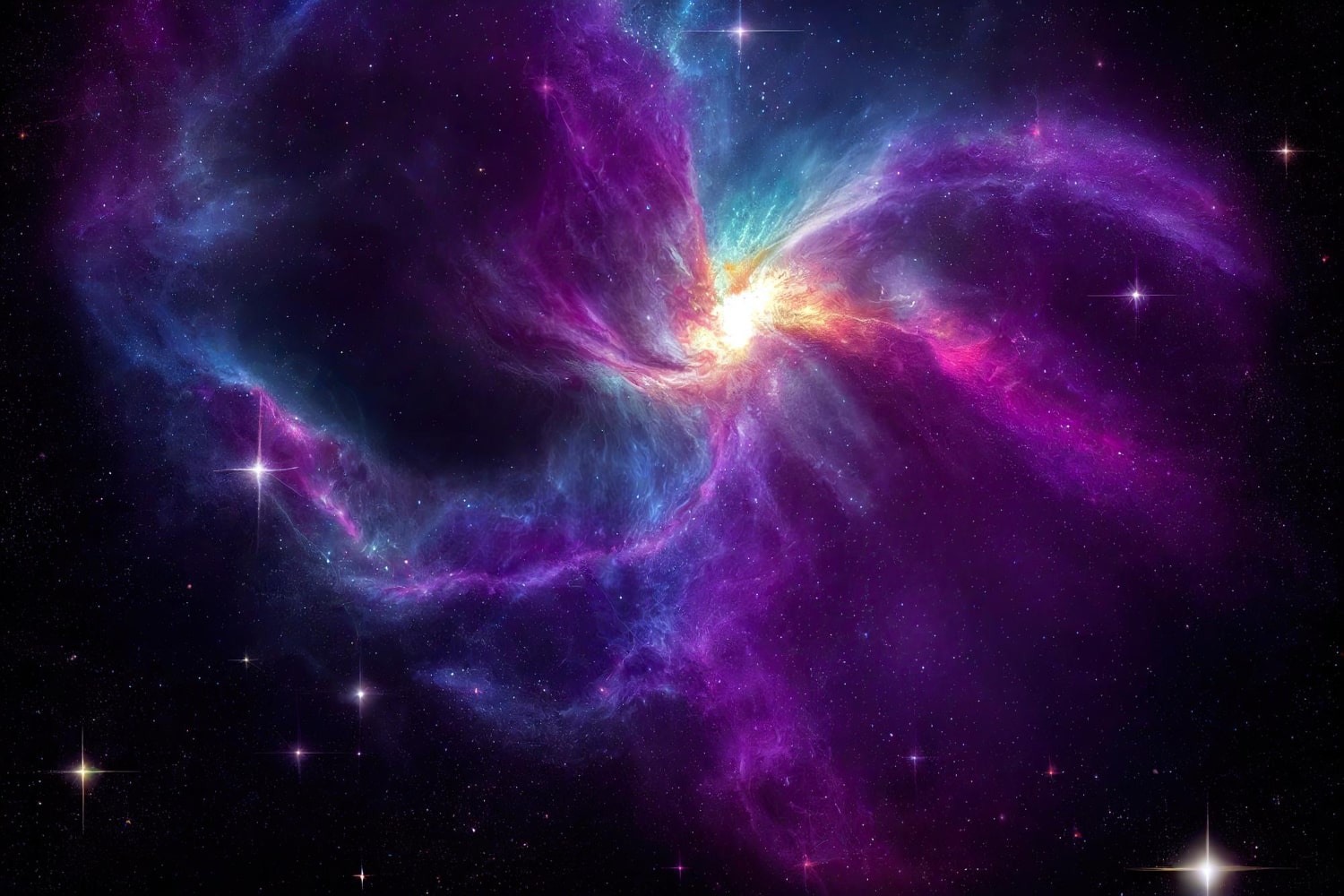
The universe is inhabited by billions of galaxies, each of which is a vast island of stars, planets, gas, and dust. These cosmic structures amaze us with their scale and diversity of forms. The study of galaxies reveals incredible facts about the structure of the universe and its evolution. Some of these facts are so astonishing that they force us to reconsider our place in the cosmos. Let’s dive into the fascinating world of galactic mysteries that you may not have known about.
- In spiral galaxies, stars rotate around the center along elegant arms that resemble a cosmic whirlpool. Our Milky Way belongs to this very type and has four main spiral arms. Interestingly, stars move through these arms, while the arms themselves remain in place like density waves. The rotational speed of the Sun around the galactic center is approximately 220 kilometers per second.
- The largest known galaxy IC 1101 exceeds the Milky Way in size by 50 times. Its diameter reaches approximately 6 million light-years. This giant elliptical galaxy contains more than 100 trillion stars. It is located at a distance of about 1 billion light-years from Earth.
- The Andromeda and Milky Way galaxies are steadily approaching each other at a speed of 110 kilometers per second. In approximately 4.5 billion years, they will collide and begin to merge into one giant galaxy. Astronomers have already invented a name for the future merger – Milkomeda or Milkdromeda. Despite the collision of galaxies, the probability of individual stars colliding is negligibly small due to the enormous distances between them.
- In the center of virtually every large galaxy hides a supermassive black hole. The mass of such a black hole can exceed the mass of the Sun by millions or even billions of times. The black hole in the center of the Milky Way is called Sagittarius A* and weighs approximately 4 million solar masses. It is precisely the gravity of this black hole that holds the entire galaxy together.
- Dwarf galaxies are the most common type of galaxies in the universe, although they are the least noticeable. Some of them contain only a few million stars, which is small compared to the 200-400 billion stars of the Milky Way. More than 50 such dwarf satellite galaxies orbit around our galaxy. The closest of them are the Large and Small Magellanic Clouds, visible to the naked eye in the southern hemisphere.
- The Sombrero Galaxy received its name due to its resemblance to a Mexican hat. It has an unusually large central bulge and a bright ring of dust around it. In its center lies a black hole with a mass of about 1 billion solar masses. The distance to this amazing galaxy is approximately 28 million light-years.
- The first galaxies began to form as early as 400-500 million years after the Big Bang. They were significantly smaller and more chaotic than modern galaxies. Over time, small galaxies merged, forming larger structures. The James Webb Telescope has allowed astronomers to observe some of these ancient galaxies, whose light has traveled to us for more than 13 billion years.
- The Whirlpool Galaxy was the first galaxy in which a spiral structure was discovered back in 1845. It is located at a distance of about 23 million light-years in the constellation Canes Venatici. This galaxy actively interacts with its smaller neighbor NGC 5195. Their gravitational interaction causes intense star formation in the spiral arms.
- Irregular galaxies have no clear structure and often appear chaotic. The Large Magellanic Cloud is an example of such a galaxy and at the same time the brightest object in the night sky after the Milky Way. The irregular shape is often the result of gravitational interaction with other galaxies. In such galaxies, new stars are usually actively being born.
- Galaxies form huge structures called clusters and superclusters. The Milky Way is part of the Local Group of galaxies, which numbers more than 50 members. The Local Group, in turn, is part of the Virgo Supercluster. The largest known supercluster is called Laniakea and contains approximately 100 thousand galaxies.
- Some galaxies are called active due to their extremely bright and energetic nuclei. This is associated with the absorption of matter by a supermassive black hole in their center. Quasars are the brightest type of active galaxies and can shine brighter than all the stars of the galaxy combined. Some quasars are so bright that they can be seen at distances of billions of light-years.
- The Triangulum Galaxy is the third largest in the Local Group after Andromeda and the Milky Way. It contains approximately 40 billion stars and is located at a distance of about 3 million light-years from us. One of the largest star formation zones among known galaxies has been discovered in this galaxy. On a clear dark night, it can be seen with the naked eye.
- Dark matter makes up about 85% of all matter in galaxies, although we cannot directly observe it. It is precisely thanks to the gravity of dark matter that galaxies are held together and do not fly apart during rotation. Scientists discovered its existence by observing the movement of stars and gas in galaxies. The nature of dark matter remains one of the greatest mysteries of modern astrophysics.
- The Cigar Galaxy or M82 is experiencing an extremely intense period of star formation, 10 times more powerful than in the Milky Way. This process is caused by gravitational interaction with the neighboring galaxy M81. In the center of M82, new stars are being born so rapidly that they create a powerful galactic wind. This wind ejects enormous amounts of gas and dust into intergalactic space.
- The distances between galaxies are so vast that light travels through them for millions and billions of years. When we look at distant galaxies, we see them as they were in the distant past. The most distant galaxies we observe show the universe as it was a few hundred million years after the Big Bang. This makes astronomy a unique science where one can literally look into the past.
Galaxies continue to reveal fascinating facts about the infinity of space and the laws governing the universe. Each new study brings incredible discoveries about these magnificent structures. Thanks to modern telescopes, we can look ever further into space and time, uncovering the mysteries of the birth and evolution of galaxies. The study of these cosmic islands helps us understand not only the past of the universe but also predict its future.


