
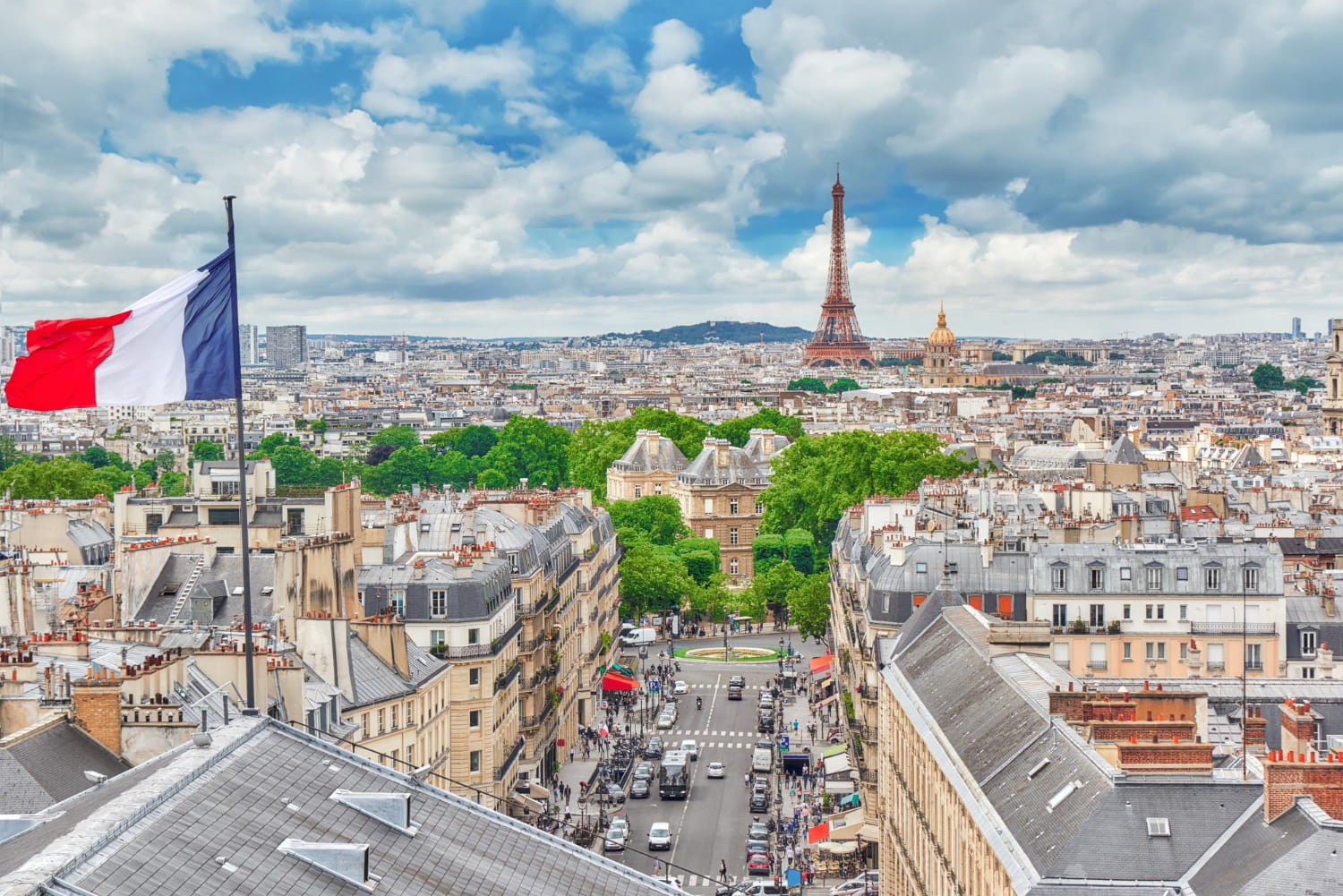
France stands as a nation where history breathes on every street corner while modernity harmoniously intertwines with centuries of heritage creating an atmosphere of refined elegance and intellectual depth. From the snow-capped peaks of the Alps to the azure shores of the Mediterranean from Parisian boulevards to tranquil provincial villages every corner of this land tells its own captivating story. Amazing facts about France reveal a country that became the cradle of revolutions artistic movements and scientific breakthroughs profoundly shaping global civilization. You might not know that France is the largest country in the European Union by area or that it possesses more time zones than any other nation on Earth thanks to its overseas territories scattered across the globe. Fascinating facts about France will help you discover this multifaceted nation from an entirely fresh perspective.
- France ranks as the largest country in the European Union by land area covering more than six hundred forty thousand square kilometers which places it thirteenth globally in terms of total territory. This vast expanse includes not only metropolitan France in Western Europe but also numerous overseas departments and territories distributed across every continent and ocean basin. Thanks to these far-flung possessions France maintains the greatest number of time zones of any country worldwide with twelve distinct zones spanning the planet. This remarkable geographic distribution means that at any given moment some part of French territory is always experiencing the dawn of a new day.
- The French language holds the distinction of being the second most widely used language in international diplomacy after English and serves as an official language for the United Nations European Union and numerous other international organizations. While approximately sixty seven million people reside within France itself nearly two hundred fifty million individuals worldwide speak French as either their first or second language. France actively promotes its linguistic heritage through the Alliance Française network operating in more than one hundred thirty countries globally. This language policy forms an essential component of France’s soft power strategy enhancing its cultural influence and diplomatic reach across continents.
- Paris consistently ranks among the world’s most visited cities welcoming over thirty million tourists annually who come to experience the Eiffel Tower the Louvre and countless other cultural treasures. The Eiffel Tower was originally conceived as a temporary structure built for the 1889 World’s Fair with plans to dismantle it after twenty years had elapsed. Its practical value for radio transmission ultimately saved the tower from destruction and today it stands as the world’s most visited paid monument attracting millions of admirers. Interestingly the tower actually grows approximately half a meter taller during summer months due to thermal expansion of its iron framework.
- France holds the record for the most victories in the Eurovision Song Contest having won the competition eight times which places it among the most successful nations in the contest’s history. The country was one of four founding participants alongside Germany Italy and the Netherlands when the competition launched in nineteen fifty six. France also stood as the sole candidate to host the twenty twenty four Summer Olympics after other potential hosts withdrew citing prohibitive costs. Paris will welcome the Summer Games for the third time in its history following previous hosting duties in nineteen hundred and nineteen twenty four.
- French cuisine earned recognition as part of UNESCO’s Intangible Cultural Heritage list in two thousand ten highlighting its profound significance to global gastronomic traditions. A traditional French meal often extends over several hours featuring multiple sequential courses beginning with an aperitif and concluding with a digestif. France produces more wine than any other nation globally and boasts over three thousand distinct cheese varieties many protected by strict appellation regulations. Remarkably the French consume more cheese per capita than any other population on Earth reflecting their deep culinary devotion.
- France became the first country in the world to abolish slavery in seventeen ninety four although this decree was temporarily reversed by Napoleon in eighteen oh two. Final and permanent abolition occurred throughout French colonies through an eighteen forty eight decree championed by abolitionist Victor Schœlcher. France also granted women the right to vote earlier than many Western nations in nineteen forty four though implementation required the conclusion of World War II. In nineteen sixty France became the fourth nation to develop nuclear weapons thereby confirming its status as a major global power with independent defense capabilities.
- France possesses more castles than any other country worldwide with over ten thousand historic fortresses and palaces scattered across its territory. Among these the Palace of Versailles particularly stands out having served as the principal royal residence for centuries and symbolizing the absolute power of French monarchy. Chambord Castle in the Loire Valley ranks as the region’s largest château featuring unique architecture blending medieval defensive elements with Renaissance decorative flourishes. Many French castles now welcome visitors having been transformed into museums hotels or venues for cultural events and celebrations.
- France leads the world in high speed rail technology through its TGV system launched in nineteen eighty one which remains among the fastest conventional rail networks globally. The inaugural TGV journey between Paris and Lyon required merely two hours compared to the four hours previously necessary for the same route. Modern TGV trains regularly achieve speeds exceeding three hundred twenty kilometers per hour making them competitive with air travel for medium distance journeys. France also pioneered magnetic levitation train technology though commercial implementation of maglev systems has remained limited compared to conventional high speed rail.
- France stands as the world’s largest producer of truffles and Roquefort cheese while maintaining the most extensive network of premium wine producing vineyards. The nation generates more than one quarter of the world’s total wine production across seven major viticultural regions each celebrated for distinctive varietals and terroir characteristics. Many French vineyards trace their origins to Roman times with certain monastic vineyards operating continuously for over one thousand years. Intriguingly French law prohibits restaurants from serving complimentary water unless customers have ordered food or beverages a regulation reflecting the nation’s culinary philosophy.
- France houses the world’s largest art museum the Louvre which welcomes more than ten million visitors annually making it the most frequented museum on Earth. To manage overwhelming visitor numbers architect I M Pei designed the iconic glass pyramid entrance completed in nineteen eighty nine. The Louvre’s collection encompasses more than three hundred fifty thousand artifacts though spatial constraints permit only a fraction to be displayed simultaneously. The museum’s most famous painting the Mona Lisa draws thousands of daily admirers despite many visitors expressing surprise at its modest physical dimensions.
- France maintains the greatest number of international land borders in Europe sharing frontiers with eight continental neighbors while also bordering Brazil through its overseas department of French Guiana. This unique geographic situation makes France the only nation possessing terrestrial boundaries with both Europe and South America simultaneously. France additionally stands as the sole country bordering Belgium Luxembourg Germany Switzerland Italy Monaco Spain and Andorra. This strategic position establishes France as a crucial transportation hub connecting diverse regions across the European continent.
- France leads the world in nuclear energy dependence generating more than seventy percent of its electricity from nuclear reactors the highest percentage among major industrialized nations. The country operates fifty six active nuclear reactors distributed across nineteen power plants throughout its metropolitan and overseas territories. France also functions as a significant exporter of electrical energy particularly to Italy Germany and the United Kingdom during periods of surplus production. This nuclear reliance has enabled France to maintain one of the lowest per capita carbon dioxide emission rates among developed industrial nations.
- France serves as the birthplace of numerous scientific breakthroughs including Louis Pasteur’s development of pasteurization and Marie Curie’s unprecedented achievement of winning Nobel Prizes in two different scientific fields. French mathematician Blaise Pascal constructed the first mechanical calculator during the seventeenth century revolutionizing computational possibilities. Antoine Lavoisier earned recognition as the father of modern chemistry and first articulated the law of conservation of mass. France also pioneered the metric system of measurement which has become the global standard for scientific and commercial applications worldwide.
- France boasts the highest number of Blue Flag beaches among European nations signifying exceptional water quality and environmental management standards. The country also hosts Europe’s tallest sand dune the Dune of Pilat situated near Bordeaux reaching heights exceeding one hundred fifty meters above sea level. The French Riviera features unique mineral springs some utilized for therapeutic purposes continuously for more than two thousand years. Notably French law strictly prohibits labeling any sparkling wine as champagne unless it originates from the designated Champagne region protecting this prestigious appellation.
Fascinating facts about France convince us that this nation represents a genuine treasure of humanity’s cultural and historical legacy. They remind us that true greatness often manifests not through territorial expanse but through profound influence on global civilization across art science and philosophy. Studying France provides valuable lessons about preserving national identity while maintaining openness to diverse cultural influences and perspectives. Every corner of this extraordinary country tells a story of human creativity perseverance and the enduring pursuit of beauty that has shaped our modern world across centuries.


