
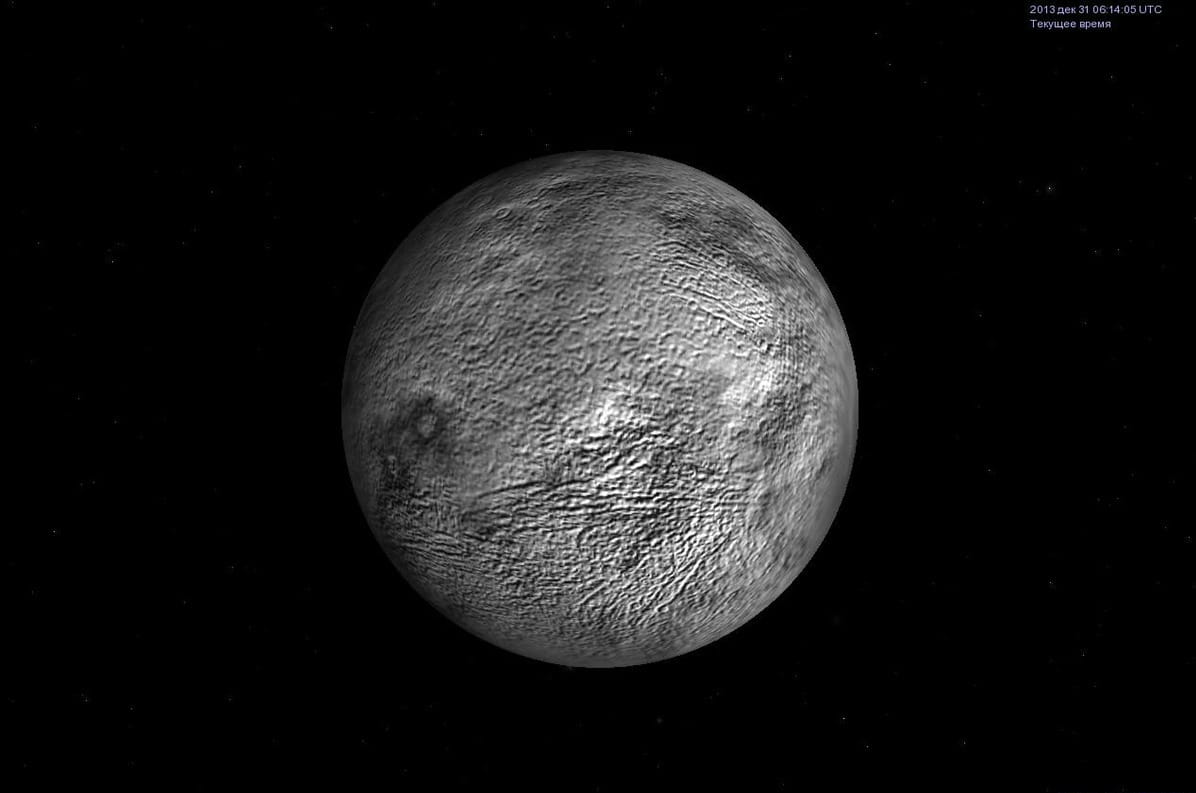
In the vast expanse of the Solar System, far beyond the orbit of Neptune, lies one of the most enigmatic dwarf planets—Eris. Discovered only in the early 21st century, it instantly reshaped our understanding of what constitutes a planet and even triggered a major reclassification of celestial bodies by the International Astronomical Union. Though Eris resides at the very edge of what Earth-based telescopes can observe, scientists have already uncovered astonishing details about this distant world. This article compiles the most fascinating facts about Eris, offering deeper insight into its nature and significance. You may not have known that the story of this icy giant—more massive than Pluto—has been filled with scientific drama and paradigm-shifting revelations.
- Eris was discovered in 2005 by a team of astronomers led by Michael Brown at the California Institute of Technology during observations of objects in the Kuiper Belt. At the time of its discovery, it appeared to be the largest known object beyond Neptune’s orbit, causing a major sensation in the scientific community. The mere existence of Eris directly prompted the International Astronomical Union to revisit and redefine the term “planet.” As a result, both Pluto and Eris were reclassified as dwarf planets in 2006.
- Eris is the most massive known dwarf planet in the Solar System, even though it is slightly smaller in diameter than Pluto. Its mass exceeds Pluto’s by approximately 27 percent, a figure precisely determined through observations of its moon, Dysnomia. This discovery forced astronomers to reconsider the assumption that size always correlates with mass. Eris’s high density indicates a substantial rocky core beneath its icy crust.
- Eris follows one of the most elongated and highly inclined orbits among large Solar System bodies. It travels along an elliptical path, ranging from about 38 astronomical units (AU) at its closest approach to the Sun to a staggering 97 AU at its farthest point. A single orbit around the Sun takes Eris more than 557 Earth years to complete. This extreme orbit makes Eris one of the most distant known objects that regularly circles our star.
- The surface of Eris is remarkably bright and almost entirely covered in frozen methane. This gives it one of the highest reflectivities in the Solar System, with an albedo of about 0.96—meaning it reflects 96 percent of the sunlight that strikes it. Such intense reflectivity masks surface features, making detailed study difficult even with powerful telescopes. Scientists suspect that beneath this thin layer of methane ice lie complex geological structures yet to be revealed.
- Surface temperatures on Eris are among the coldest recorded for any large body in the Solar System, plunging to approximately minus 243 degrees Celsius. At such extremes, any atmosphere—if it exists—is only temporary, forming briefly when Eris nears the Sun during its long orbit. For most of its journey, Eris remains a virtually airless world, shrouded in perpetual cold and silence.
- Eris has one known moon, Dysnomia, named after the Greek goddess of lawlessness and daughter of Eris herself. Discovered in 2005 shortly after the dwarf planet, Dysnomia played a crucial role in allowing astronomers to calculate Eris’s mass accurately. With a diameter of roughly 700 kilometers, Dysnomia likely formed from a collision early in the system’s history—a common origin scenario for moons in the outer Solar System.
- The name “Eris” comes from the Greek goddess of discord and strife, a fitting choice given the controversy its discovery ignited within the astronomical community. Before receiving its official name, the object was informally nicknamed “Xena” after a television character. In 2006, the International Astronomical Union formally adopted the name Eris, cementing its place in astronomical history. The name proved prophetic, as Eris indeed sowed discord—leading directly to Pluto’s demotion.
- Eris belongs to a group of objects known as the scattered disc, which were gravitationally scattered outward by interactions with the giant planets during the early formation of the Solar System. This explains its highly eccentric and tilted orbit. Unlike most Kuiper Belt objects that orbit near the ecliptic plane, Eris travels at a steep angle, making it a unique tracer of the dynamic processes that shaped our planetary neighborhood.
- Despite its immense distance, Eris was observed during a stellar occultation in 2010, when it passed directly in front of a distant star. By measuring the dip in the star’s brightness, astronomers precisely determined Eris’s diameter to be about 2,326 kilometers—slightly smaller than Pluto’s. This rare event confirmed Eris’s status as one of the largest trans-Neptunian objects and provided invaluable data for planetary science.
- To date, no spacecraft has visited Eris, and there are no approved missions planned to explore it in the foreseeable future. Due to its extreme remoteness, a journey to Eris would take several decades even with current propulsion technology. Nevertheless, astronomers continue to study it using ground-based observatories and the Hubble Space Telescope. Each new observation adds another piece to the puzzle of this remote and mysterious world.
- Eris appears to be geologically inactive, unlike Pluto, where NASA’s New Horizons mission revealed young plains and possible cryovolcanoes. Eris’s surface is likely ancient and dormant, a consequence of its relatively small size and lack of internal heat sources. However, its high reflectivity makes it difficult to confirm surface details without close-up imaging. Future observatories like the James Webb Space Telescope may one day reveal more about its hidden terrain.
- Some scientists hypothesize that Eris originally formed much closer to the Sun and was later ejected to the outer fringes of the Solar System through gravitational encounters with Neptune or other giant planets. This could explain its high density and compositional differences compared to typical Kuiper Belt objects. Such dynamical scattering was common during the first few hundred million years of the Solar System’s history. Thus, Eris stands as a living relic of that chaotic and formative era.
These interesting facts about Eris demonstrate how even the most distant corners of our Solar System continue to yield profound discoveries. The incredible details about its mass, orbit, and historical impact remind us that small worlds can provoke major shifts in scientific understanding. The captivating insights into Eris leave room for future exploration and underscore that the cosmos still holds countless mysteries awaiting their discoverers.


