
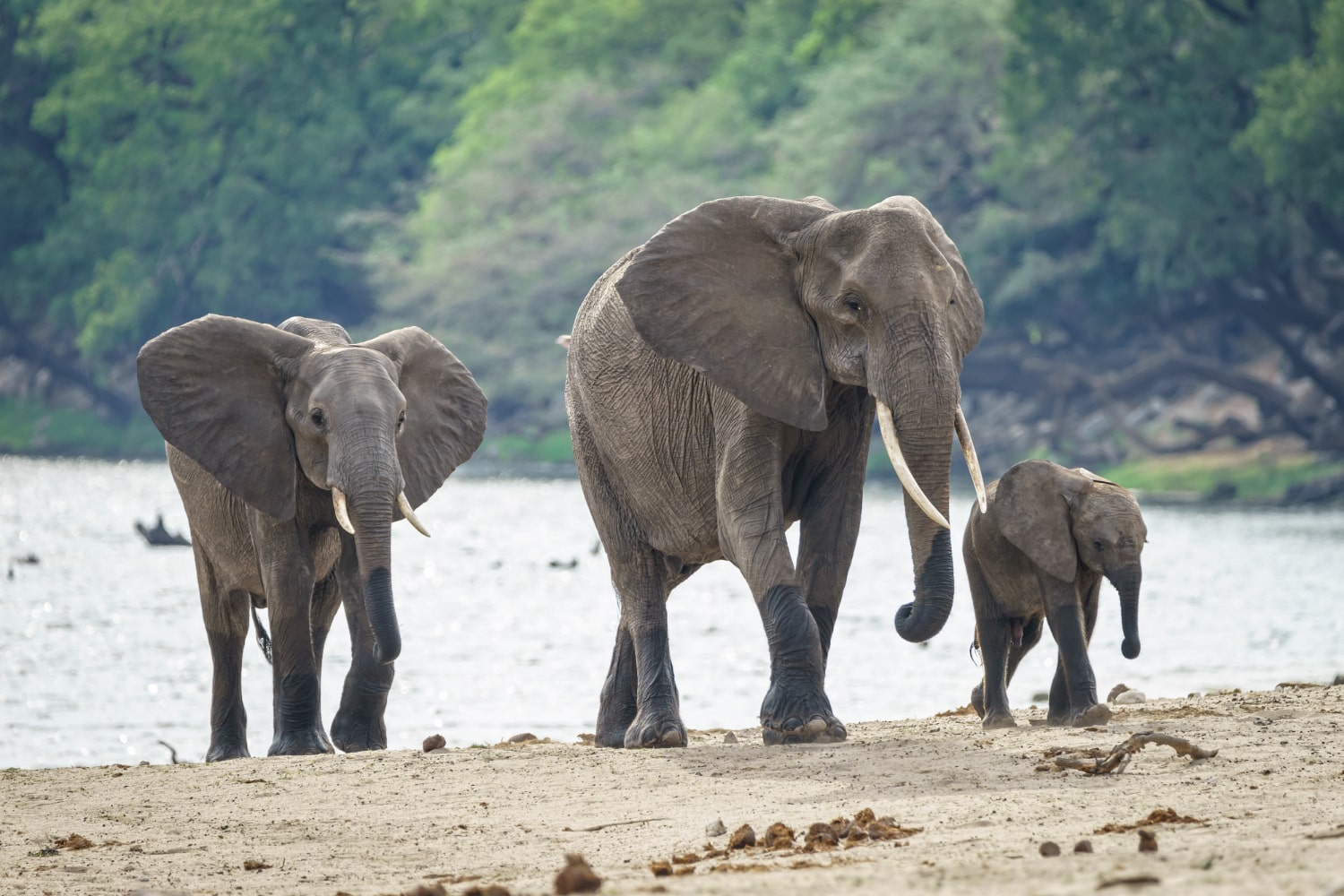
Elephants are the largest land animals on our planet, amazing not only with their gigantic size but also with their extraordinary intelligence and complex social organisation. These majestic creatures have inhabited Africa and Asia for millions of years and play a crucial role in their ecosystems. You may not have known that elephants are capable of experiencing emotions similar to those of humans, including joy, grief, and compassion. Fascinating facts about these animals will open up a world of incredible abilities and behavioural characteristics that make elephants among the most astonishing creatures on Earth.
- Elephants are the only animals that cannot jump, which is explained by their enormous mass and the particular structure of their leg bones. Their legs are constructed like sturdy columns designed to support weights of up to seven tonnes. Unlike most mammals, all the bones in an elephant’s legs are directed downward, which provides stability but makes jumping impossible. This anatomical feature also means that elephants always have at least one foot on the ground while walking.
- An elephant’s trunk is a unique organ that contains over 40,000 muscles and has no bones whatsoever. This extraordinary organ combines the functions of the nose and upper lip, allowing the elephant to breathe, smell, drink, grasp objects, and produce sounds. The trunk is so sensitive that an elephant can pick up a tiny seed from the ground, yet strong enough to uproot a tree. An adult elephant can draw up to eight litres of water into its trunk at once.
- Elephants have the longest gestation period of any land animal, lasting approximately 22 months. A newborn calf weighs around 100 kilograms and can stand on its feet within an hour of birth. Mothers and other females in the herd help the baby stand and take its first steps. Elephant calves remain dependent on their mother’s milk for the first two to three years of life.
- The ears of African elephants have a shape resembling the outline of the African continent, while the ears of Asian elephants are smaller and resemble the outline of India. Large ears serve not only for hearing but also for thermoregulation, as a dense network of blood vessels runs through them. By flapping their ears, elephants cool the blood circulating close to the skin’s surface. This allows them to lower their body temperature by several degrees in hot weather.
- Elephants display behaviour that indicates awareness of death and the capacity for grief. They often return to places where members of their herd have died and touch the bones with their trunks and feet. Elephants may spend hours by the body of a deceased relative, producing low-frequency sounds. There are known cases where elephants have attempted to cover the bodies of deceased individuals with branches and earth.
- An elephant’s brain is the largest of all land animals and weighs approximately five kilograms. Elephants possess extraordinary memory and are capable of remembering the locations of water sources, other elephants, and migration routes for decades. This ability is particularly important during droughts, when older females lead the herd to water they remember from their youth. Elephants can also recognise hundreds of other elephants even after many years of separation.
- Elephants communicate using low-frequency sounds called infrasound, which can travel distances of up to ten kilometres. These sounds have a frequency below the threshold of human hearing, so we cannot hear them without specialised equipment. Elephants also sense ground vibrations through sensitive nerve endings on the soles of their feet. In this way, they can receive messages from other elephants that are far beyond the range of sight.
- An elephant’s skin can be up to 2.5 centimetres thick, yet it is extraordinarily sensitive and can detect even a fly landing on it. The wrinkles and folds in the skin help retain moisture and mud, which protects against sunburn and parasites. Elephants regularly take mud and dust baths to protect their skin. Despite its thickness, their skin can become sunburned, so elephants often seek shade during the hottest hours.
- Elephant tusks are modified incisors that grow throughout the animal’s entire life. African elephants have tusks in both males and females, while in Asian elephants tusks are found predominantly in males. Tusks are used for digging, stripping bark from trees, defence, and fighting for females. The largest recorded tusk weighed over 100 kilograms and was more than three metres long.
- Elephants are among the few animals capable of recognising themselves in a mirror, which indicates a high level of self-awareness. This ability, besides elephants, is demonstrated only by great apes, dolphins, and some birds of the crow family. Experiments have shown that elephants can use mirrors to examine parts of their body that they cannot otherwise see. This ability is considered a sign of complex cognitive development.
- Elephants can consume up to 150 kilograms of food and drink up to 200 litres of water per day. Their diet consists mainly of grass, leaves, bark, roots, and fruits. Due to the low efficiency of their digestion, elephants absorb only about 40 percent of the food they eat. This means they spend up to 16 hours a day searching for and eating food.
- The social structure of elephants is based on matriarchy, where the herd is led by the oldest and most experienced female. The herd usually consists of females and their young, while adult males live predominantly alone or in temporary bachelor groups. The matriarch makes decisions about migration routes, feeding grounds, and watering holes. Her knowledge and experience are critically important for the survival of the entire herd.
- Elephants demonstrate empathy and help other herd members who have found themselves in difficulty. They help lift weak or sick individuals by supporting them with their bodies. Elephants also care for the young of other females, which is called alloparenting. There are known cases where elephants have helped other animal species that have become trapped.
- The African elephant is the largest land mammal, reaching heights of up to four metres at the shoulder and weights of up to seven tonnes. The Asian elephant is somewhat smaller, with a maximum height of about 3.5 metres and weight of up to five tonnes. There is also the African forest elephant, which is a separate species and smaller than the savannah elephant. All three species are endangered due to poaching and habitat loss.
- Elephants are capable of swimming and can cross significant water obstacles using their trunk as a breathing tube. They are excellent swimmers and can spend several hours in the water without tiring. Elephants also enjoy playing in water, spraying themselves and other herd members. Swimming helps them cool down in hot weather and cross rivers during migrations.
- The lifespan of elephants in the wild ranges from 60 to 70 years, making them among the longest-lived mammals. In captivity, elephants can live longer with proper care. The oldest known elephant reached an age of over 80 years. Elephants, like humans, pass through various life stages, including childhood, adolescence, maturity, and old age.
- Elephant footprints create mini-ecosystems that fill with water during rains and become homes for frogs, insects, and small fish. Elephants also disperse plant seeds over great distances through their dung. Their activity of felling trees creates clearings that promote biodiversity. Because of this influence on the environment, elephants are called keystone species or ecosystem engineers.
- Elephants have a unique structure to the soles of their feet with a fatty pad that cushions their steps and allows them to move almost silently. This soft pad expands under the weight of the body and contracts when the foot is lifted. Thanks to this, elephants can approach unnoticed despite their enormous size. Sensitive nerve endings on the soles also help detect ground vibrations.
Incredible facts about elephants demonstrate how unique and complex these giants of the animal kingdom are, combining physical strength with impressive intelligence and deep emotions. From their capacity for compassion and grief to their incredible memory and complex social bonds, elephants continue to captivate and inspire people around the world. These fascinating details remind us of the necessity of protecting these majestic animals, whose existence is under serious threat due to human activity.


