
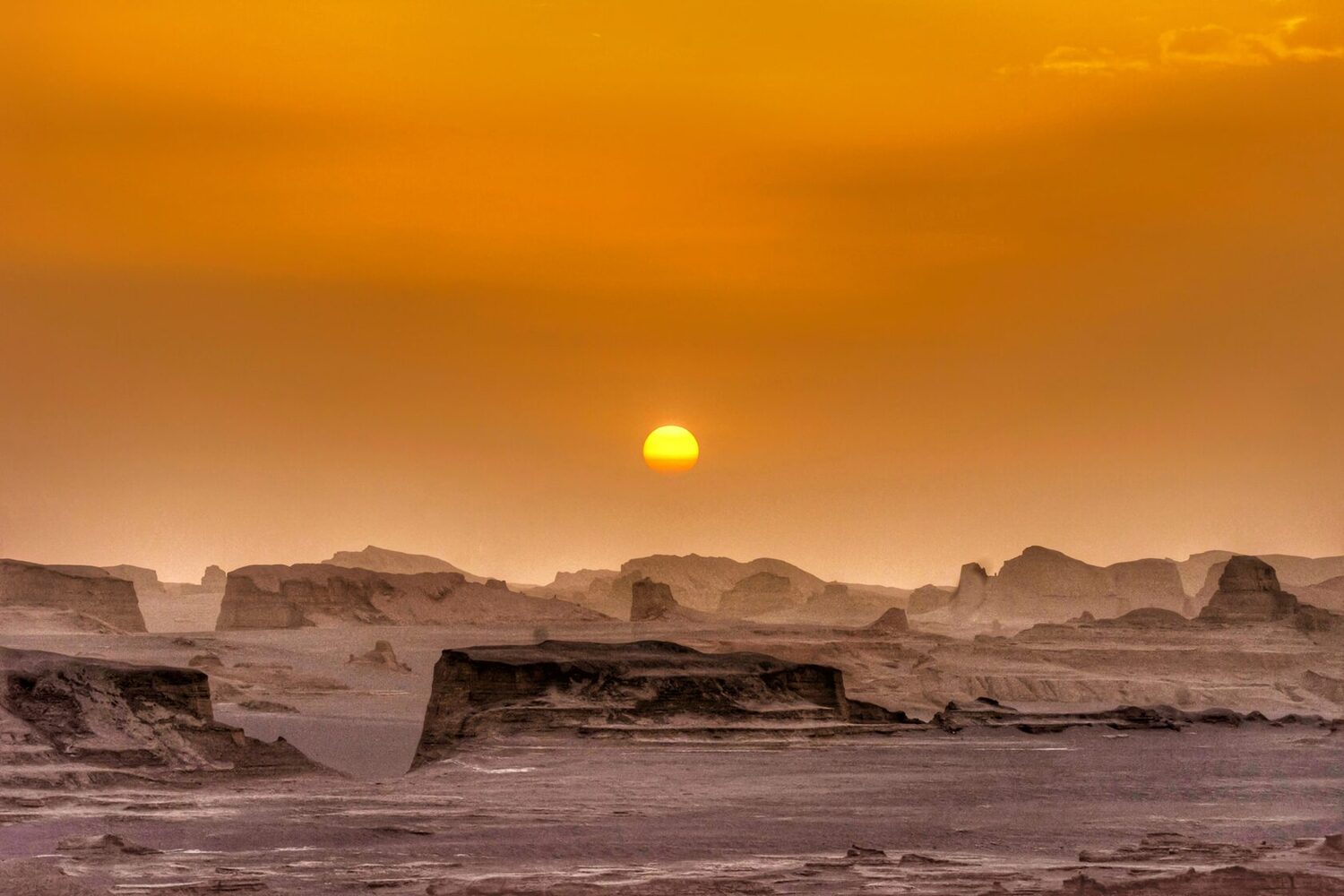
Dasht-e Lut is one of those places on Earth that seems almost unreal because of its vast scale and extreme natural conditions. This desert impresses not only with its size, but also with an environment that pushes the limits of what life can endure. Interesting facts about Dasht-e Lut reveal a landscape where nature operates without compromise and strictly follows its own laws. Here, fascinating facts are closely connected with record-breaking temperatures, unusual landforms, and the near absence of living organisms. You may not have known that such extreme regions help scientists better understand the physical limits of our planet.
- Dasht-e Lut is located in Iran and is considered one of the largest deserts in the country. It occupies a vast area in the central part of the state. The desert stretches for hundreds of kilometers in different directions. Even when observed from high above, its scale appears almost endless.
- Dasht-e Lut is widely known as one of the hottest places on Earth. In some years, record-high surface temperatures have been recorded there. The dark ground absorbs solar radiation very efficiently. Under such conditions, survival becomes nearly impossible for most forms of life.
- The name Dasht-e Lut is associated with ideas of emptiness and desolation. It accurately reflects the harsh character of the region. Permanent human settlements are virtually nonexistent. Even nomadic groups avoid staying in this area for long periods.
- One of the most remarkable features of Dasht-e Lut is the presence of kaluts. These are massive natural formations resembling the ruins of ancient cities. Wind and sand sculpted their shapes over thousands of years. The result is a landscape that appears both spectacular and unsettling.
- Wind plays a decisive role in shaping the terrain of Dasht-e Lut. It constantly transports sand and fine dust across the desert. As a result, the surface of the desert is always changing. The landscape here is never truly static.
- Rainfall in Dasht-e Lut is extremely rare. In some areas, rain may not fall for many consecutive years. Any moisture that does appear quickly evaporates due to intense heat. This makes the desert one of the driest regions on Earth.
- The soil of Dasht-e Lut contains large amounts of salt and minerals. In many places, the surface is covered with a hard crust. This crust formed after ancient lakes and rivers dried up. Such areas often resemble landscapes from another planet.
- Vegetation in Dasht-e Lut is extremely sparse. Only a few plant species are capable of enduring the extreme heat. These plants have special adaptations that help them conserve water. Life here survives at the very edge of what is possible.
- The animal life of Dasht-e Lut is also very limited. Some small animals are active only during the night. During the day, they hide underground or in the shade of rocks. This behavior helps them avoid lethal daytime temperatures.
- Dasht-e Lut is considered a natural laboratory for scientists. Researchers study extreme climate conditions there. The data collected is used to model environments on other planets. The desert is often compared to the surface of Mars.
- The desert plays an important role in climate change research. Its temperature extremes demonstrate the effects of intense surface heating. Scientists analyze how such conditions influence the surrounding environment. This research helps predict future climate scenarios.
- Permanent bodies of water are almost completely absent in Dasht-e Lut. Ancient rivers and lakes dried up long ago. Their traces remain in the form of vast salt flats. These features reflect a very different climate in the distant past.
- For a long time, Dasht-e Lut remained poorly explored. Its remote location and dangerous conditions made research difficult. Only with the development of satellite technology did accurate data become available. This allowed scientists to better understand the desert’s size and structure.
- Dasht-e Lut is largely unsuitable for tourism. Traveling through the desert requires careful planning and professional preparation. Even experienced explorers face serious risks. The desert environment does not forgive mistakes.
- Nighttime temperatures in Dasht-e Lut can be significantly lower than daytime temperatures. Such sharp contrasts create additional challenges. Both materials and living organisms must endure extreme temperature differences. This further limits the potential for life.
- The desert holds cultural significance for local populations. It appears in regional legends and traditional stories. Dasht-e Lut is often associated with trials and solitude. People perceive it as a symbol of nature’s uncompromising power.
- In the past, trade routes passed along the edges of the desert. Caravans tried to avoid the most dangerous areas. Even short crossings required exceptional endurance. Traveling through this region was considered extremely risky.
- Dasht-e Lut has been officially recognized as a site of natural heritage. Its unique landscapes are of global importance. Protecting this region helps preserve natural geological processes. The desert stands as a striking example of Earth’s primordial beauty.
Dasht-e Lut clearly demonstrates the extreme capabilities of our planet and reminds us of the immense power of natural forces. Its captivating facts show that even in the harshest environments, there is an underlying order and balance. You may not have realized how important such regions are for scientific research and climate understanding. Interesting facts about Dasht-e Lut emphasize that deserts are not empty wastelands, but unique and valuable parts of Earth.


