
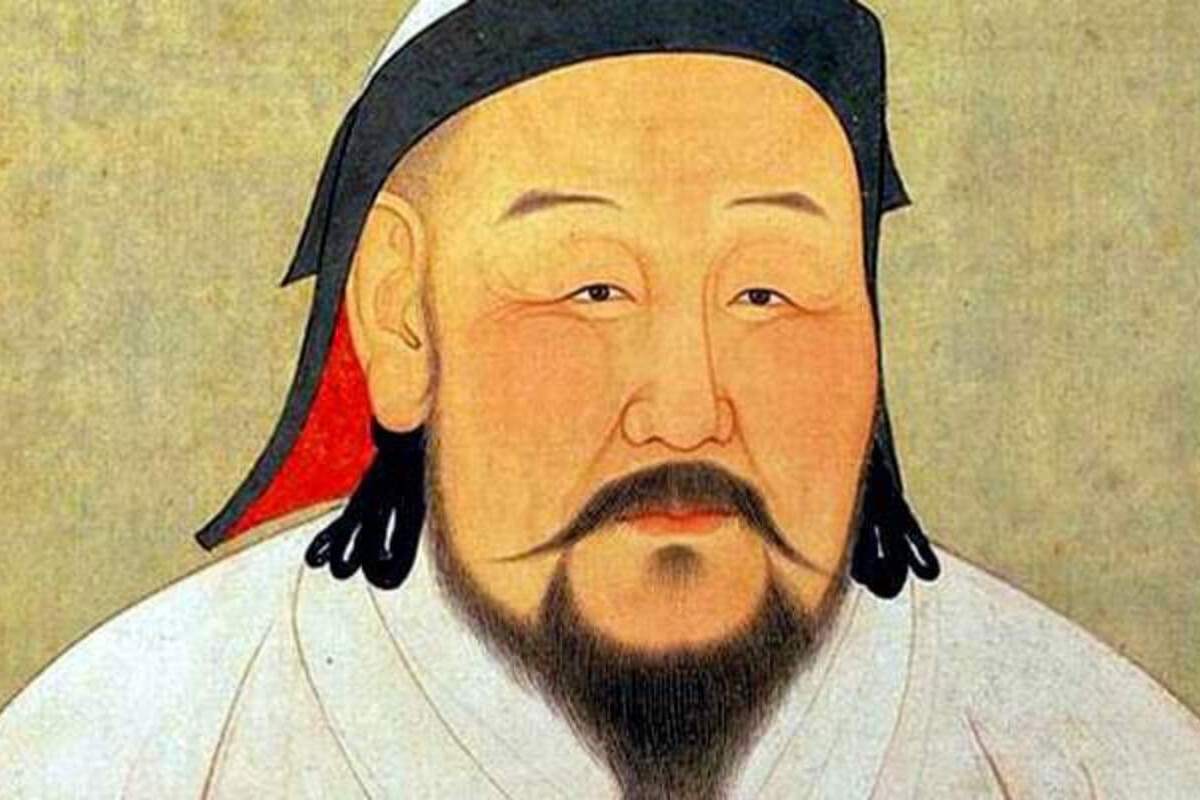
Genghis Khan is one of the most influential and controversial figures in human history, whose empire became the largest contiguous land state of all time. This Mongolian conqueror changed the map of the world by uniting nomadic tribes and creating a powerful military machine. His life is shrouded in legends, and his legacy continues to influence the modern world through genetics, culture, and geopolitics. During his lifetime he was known as a ruthless warrior, but also as a wise ruler and reformer. Get acquainted with incredible facts about Genghis Khan that you may not have known about.
- Genghis Khan’s real name was Temujin, and he was born approximately in 1162 in the area of the Onon River on the territory of modern Mongolia. The name Genghis Khan, meaning “universal ruler” or “oceanic khan”, he received in 1206 after uniting the Mongolian tribes. The exact date of his birth remains a subject of debate among historians. He was born into the family of the leader of the Borjigin tribe, which belonged to the Mongolian aristocracy.
- In childhood, Temujin experienced tragedy when his father Yesugei was poisoned by a hostile Tatar tribe. After his father’s death, his family was abandoned by their own tribe and forced to survive in poverty. This difficult youth hardened the character of the future conqueror and taught him to value loyalty. As a teenager, Temujin was even captured by a hostile clan and locked in wooden stocks.
- Genghis Khan created the Mongol Empire, which at the peak of its prosperity covered a territory of more than 24 million square kilometers. This empire stretched from the Pacific Ocean to Eastern Europe and from Siberia to the Persian Gulf. This was the largest contiguous land empire in human history. Approximately one quarter of the world’s population at that time was under his control.
- The Mongol army under Genghis Khan’s leadership was one of the most effective military forces in history thanks to innovative tactics and organization. The Mongols perfected the technique of cavalry combat and used complex composite bows that could shoot at distances of over 300 meters. The troops were organized according to a decimal system from tens to ten thousand warriors. Mongolian horsemen could ride for several days without stopping, changing horses and eating even in the saddle.
- Genghis Khan introduced one of the world’s first codes of law called the Yassa, which regulated both military and civil aspects of life in the empire. This code established harsh punishments for crimes, but also protected property rights and guaranteed religious tolerance. The Yassa prohibited the kidnapping of women, the sale of women into marriage, and the enslavement of Mongols. Under this law, even members of the royal family were subject to punishment for violations.
- Unlike many conquerors of his time, Genghis Khan practiced religious tolerance and exempted clergy of all faiths from taxes. Buddhists, Muslims, Christians, Taoists, and representatives of other religions peacefully coexisted in his empire. Genghis Khan himself adhered to traditional Mongolian shamanism, but respected all faiths. This policy of tolerance contributed to the stability of the vast multinational empire.
- Genghis Khan established a system of postal relay stations, which was one of the most effective communication networks of the Middle Ages. Postal stations were located at a day’s journey distance from each other throughout the empire. Couriers could change horses at each station, which allowed messages to be delivered with incredible speed. This system became the prototype for many later postal services in the world.
- According to geneticists’ estimates, about 16 million men in the world are direct descendants of Genghis Khan through the male line. This represents approximately 0.5 percent of the entire male population of Earth. Y-chromosome studies showed that this genetic line suddenly spread about 1000 years ago, which coincides with the time of Genghis Khan. This is explained both by the large number of wives and concubines of the khan himself, and by the privileges of his numerous sons and grandsons.
- Genghis Khan encouraged meritocracy and promoted people based on their abilities rather than origin or social status. Many of his closest advisors and generals came from simple families or were even former enemies. He valued loyalty and competence above aristocratic origin. This policy allowed the attraction of the best talents from all conquered peoples.
- Mongol conquests contributed to unprecedented exchange of technologies, ideas, and goods between East and West. Under Mongol rule, the Great Silk Road became safer than ever before. Chinese technologies such as gunpowder, printing, and the compass spread to the West. Europeans first learned about many Asian goods and cultural achievements.
- Genghis Khan died in August 1227 during a military campaign against the Tangut kingdom of Xi Xia. The circumstances of his death remain mysterious, with versions ranging from falling from a horse to illness. The place of his burial was carefully hidden according to Mongolian traditions. According to legend, everyone who participated in the burial was killed to preserve the secret, and the grave has still not been found.
- After his death, guards pursued and killed everyone who was encountered on the path of the funeral procession so that no one could tell about the burial place. According to some estimates, about 2000 people may have died during the funeral. It is believed that the grave is located somewhere in the Khentii Mountains in Mongolia, possibly near the sacred mountain Burkhan Khaldun. The Mongolian government prohibits archaeological excavations in this region for religious reasons.
- Genghis Khan had four official wives and numerous concubines, but he loved his first wife Borte the most. She was kidnapped by the hostile Merkit tribe shortly after the wedding, but Temujin managed to rescue her. Their first son Jochi was born after her return, and the question of his paternity remained delicate. Despite this, Genghis Khan always treated Borte with special respect.
- The Mongol Empire under Genghis Khan was distinguished by advanced principles of governance for its time, including unified currency and writing. Genghis Khan commissioned a Uyghur scholar to adapt Uyghur script for the Mongolian language. A system of accounting and population censuses was introduced. Trade was actively encouraged, and merchants received special protection.
- Genghis Khan was ruthless to those who resisted, but merciful to those who surrendered without a fight. Cities that opened their gates to the Mongols preserved their property and self-government. Those that resisted were often completely destroyed as a warning to others. This strategy of psychological pressure often worked more effectively than direct military conquest.
- Mongol conquests had a significant ecological impact, as huge territories of agricultural lands turned into pastures. According to some studies, this led to the growth of forest areas in conquered regions. The reduction in land cultivation and decrease in population through wars could even have affected the global climate. Some scientists suggest that Mongol conquests led to carbon absorption, which cooled the planet.
Genghis Khan remains one of the most fascinating and controversial figures in human history. Interesting facts about his life and rule reveal a complex personality who was simultaneously a ruthless conqueror and a wise reformer. The legacy of Genghis Khan continues to influence the modern world through culture, genetics, and the historical memory of millions of people. His story reminds us how one person can radically change the course of world history and leave an indelible mark on the memory of generations.


