
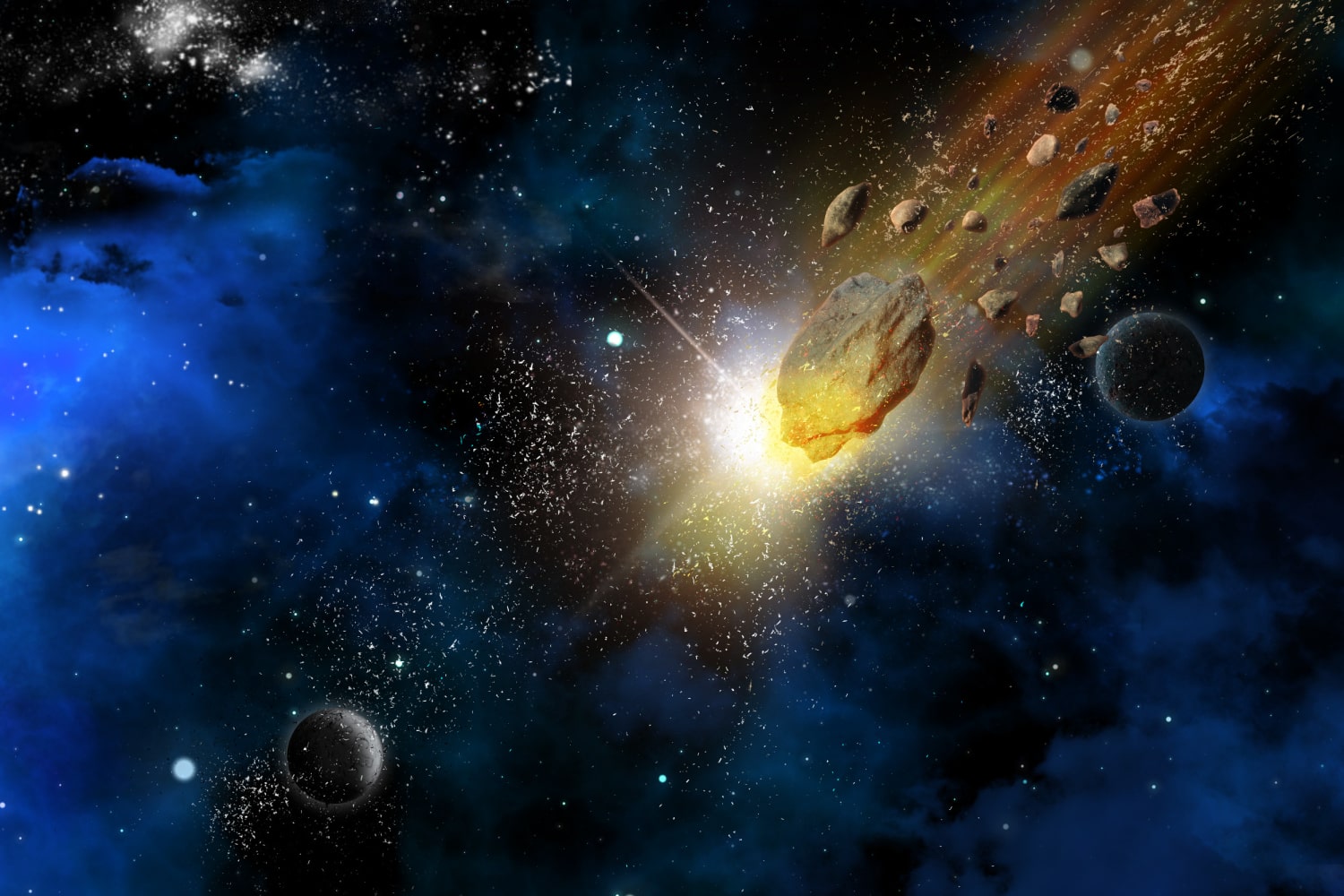
Comets have fascinated, frightened, and inspired humanity since ancient times, as their sudden appearance in the night sky has always seemed mysterious and extraordinary. In different eras, these celestial objects were seen as signs of fate, messages from gods, or omens of great change. You may not know that modern science has uncovered many incredible facts about their structure, origin, and role in the formation of the Solar System. Interesting facts about comets help explain why they are often described as time capsules from the depths of space. Fascinating facts from astronomy continue to reveal their true nature and scientific importance.
- Comets are composed mainly of ice, dust, and frozen gases. Because of this mixture, they are often described as dirty snowballs. Their nuclei can contain organic compounds. These substances are of particular interest to scientists studying the origins of life.
- The nucleus of a comet usually has an irregular shape. Its size can range from a few hundred meters to several tens of kilometers. Despite this variation, the nucleus remains the densest part of the comet. All other visible features form only when the comet approaches the Sun.
- A comet’s tail appears when it comes close enough to the Sun. Heat causes the ice to sublimate, releasing gas and dust. These materials create a glowing envelope and a long tail. This process produces one of the most fascinating sights in the night sky.
- A comet’s tail always points away from the Sun. This happens due to the influence of the solar wind. Even when a comet moves in a different direction, the tail maintains this orientation. You may not know that this property helps scientists study solar activity.
- Comets usually have two main types of tails. One tail is made of dust, while the other consists of ionized gas. They differ in shape, structure, and color. In some cases, both tails are clearly visible at the same time.
- Many comets travel along highly elongated orbits. They may return to the inner Solar System only once every few hundred or even several thousand years. Some comets appear only once and never return. These incredible facts make each observation truly unique.
- A significant number of comets originate from the Kuiper Belt. This region lies beyond the orbit of Neptune. It contains vast numbers of icy objects. Short-period comets usually come from this distant area.
- Other comets are believed to originate from the Oort Cloud. This is a massive spherical region located at the outer edge of the Solar System. It is considered the source of long-period comets. You may not know that this region has not yet been directly observed.
- Comets change with every close approach to the Sun. Portions of their material are gradually lost to space. Over time, the nucleus shrinks or breaks apart. Some comets eventually disappear completely.
- In some cases, comets split into multiple fragments. This can occur due to intense heating or the gravitational influence of large planets. Modern telescopes are able to observe such events. These observations provide valuable insights into the internal structure of comets.
- Comets may have played an important role in Earth’s history. One hypothesis suggests that they delivered part of the planet’s water. Along with water, organic molecules may also have arrived. This is one of the most incredible facts related to the origins of life.
- In ancient times, comets were often regarded as bad omens. Their appearance was linked to wars, plagues, or natural disasters. Such beliefs were widespread across many cultures. Only the development of science changed this perception.
- Well-known comets are given specific names. Most are named after their discoverers. Some comets have been observed repeatedly over many centuries. This allows scientists to track their behavior over long periods.
- Halley’s Comet is one of the most famous comets in history. It returns to the vicinity of the Sun approximately every seventy-six years. People observed it even in ancient civilizations. Its next appearance is expected in the middle of the twenty-first century.
- Some comets can become brighter than many stars. When they approach the Sun, they may be visible to the naked eye. Such events attract the attention of millions of people worldwide. Fascinating facts about these comets often spread rapidly through the media.
- Astronomers study comets using spacecraft and space probes. Some missions have even successfully landed on a comet’s nucleus. This has made it possible to directly analyze their composition. You may not know that such missions require extremely precise calculations.
- Comets are closely linked to meteor showers. When Earth passes through a trail left by a comet, a meteor shower occurs. Small particles burn up in the atmosphere, creating bright streaks of light. This beautiful phenomenon is directly connected to cometary debris.
- Not all comets become spectacular objects. Many remain faint and difficult to observe. They can be detected only with the help of telescopes. Nevertheless, even these comets are scientifically valuable.
- The orbits of comets can change under the gravitational influence of planets. Jupiter has a particularly strong effect. It can deflect comets or capture them into new orbits. This interaction determines their future paths.
- Comets are among the oldest objects in the Solar System. They preserve material that has remained almost unchanged since its formation. For this reason, scientists study them with great interest. You may not know that each comet serves as a natural archive of cosmic history.
Interesting facts about comets show that these celestial bodies are far more complex than they appear at first glance. Incredible facts about their structure and origin help scientists better understand the evolution of the Solar System. Fascinating facts turn comets into a bridge between the distant past and modern scientific discovery. You may not know that by studying comets, humanity is gradually uncovering the secrets of its own cosmic origins.


