
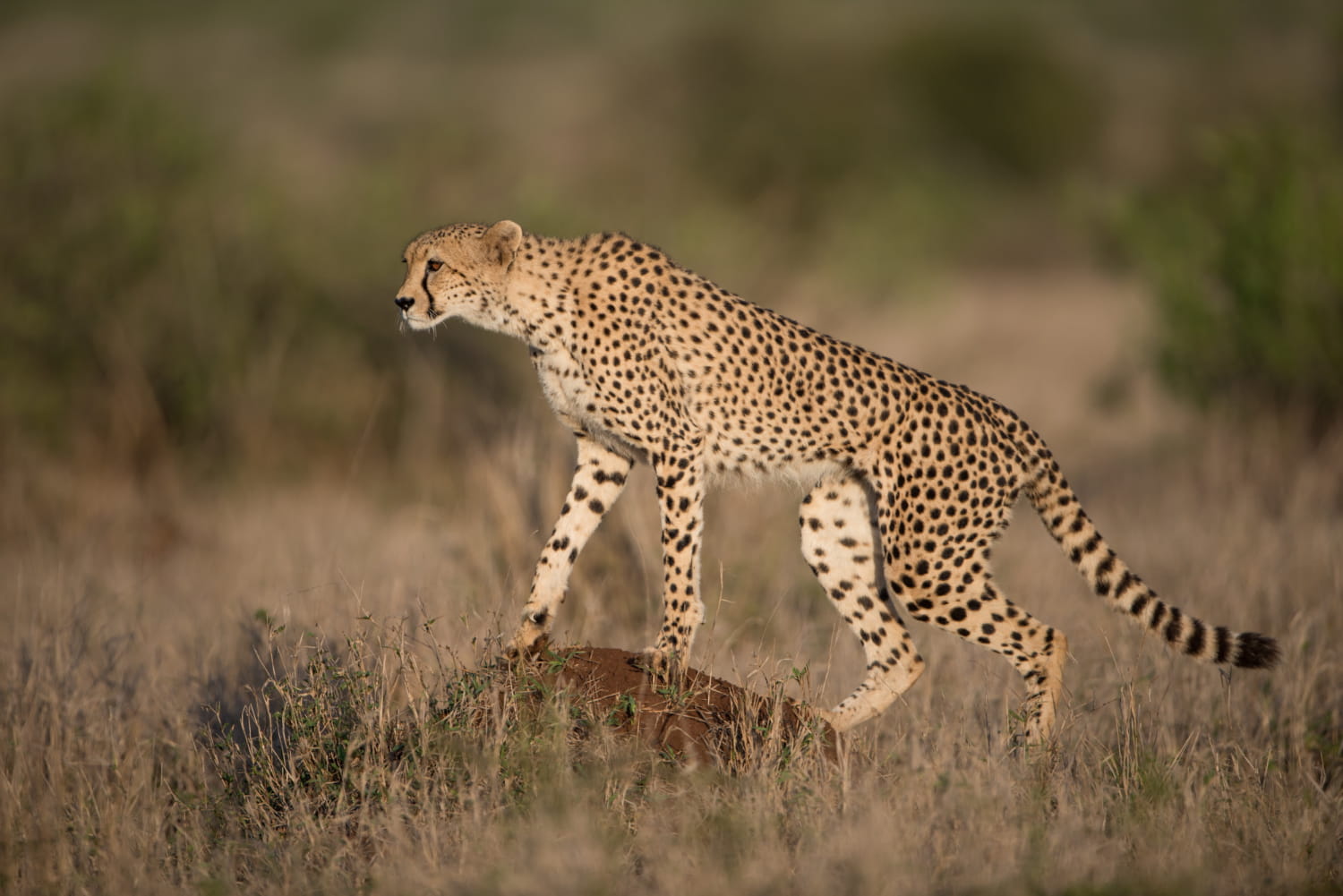
Cheetahs are far more than just the fastest land mammals on Earth—they are among the most unique and elegant predators of the savanna. Their streamlined bodies, spotted coats, and unmatched speed make them true icons of the wild. You may not have known that cheetahs cannot run for long distances or that they use “tear marks” to aid in hunting. Hidden among countless myths and misconceptions about these felines are astonishing facts that reveal their true biology and behavior. Here are some of the most captivating ones.
- Cheetahs are the fastest land animals on the planet, capable of reaching speeds between 112 and 120 kilometers per hour. However, this incredible velocity lasts only 20 to 30 seconds, as their bodies overheat rapidly during a sprint. During such bursts, a cheetah’s heart can beat up to 250 times per minute, and its breathing rate may exceed 150 breaths per minute. After a chase, the animal needs several minutes to recover its breath and regulate its body temperature.
- Unlike other big cats, cheetahs cannot roar. Instead, they communicate using sounds resembling bird-like chirps, purrs, or even barks. This is due to the structure of their larynx, which lacks the specialized elastic ligament required for roaring. Because of this anatomical feature, cheetahs are classified among the “small cats,” despite their relatively large size.
- Cheetahs possess distinctive “tear marks”—dark lines running from the inner corners of their eyes down to the sides of their mouth. These markings help reduce sun glare, much like the black grease athletes apply under their eyes. This adaptation enhances visual clarity during hunts in the bright savanna light. The stripes also assist in focusing precisely on prey at long distances.
- A cheetah’s body is exquisitely engineered for speed: it has a lightweight skeleton, long legs, a flexible spine, and a small head. Its tail acts as a rudder and stabilizer during sharp turns at high velocity. Unlike most cats, cheetahs have semi-retractable claws that provide better grip on the ground, functioning similarly to cleats on running shoes. This trait makes their gait remarkably similar to that of a human sprinter.
- Cheetahs typically hunt in the early morning or late afternoon to avoid competition with lions and hyenas. They rely primarily on sight rather than smell, often climbing termite mounds or low hills to scan the horizon. Once prey is spotted, the cheetah stalks as close as possible before launching a sudden, explosive dash. Only about 40–50 percent of hunts succeed, and frequently, other predators steal their hard-earned meal.
- Female cheetahs raise their cubs alone, often giving birth to litters of three to six. For the first three months, the cubs remain hidden in dense vegetation, frequently changing dens to evade predators. The mother teaches them to hunt by demonstrating techniques on live prey. Tragically, only around 10 percent of cubs survive to adulthood due to predation by lions and hyenas, as well as human-related threats.
- Cheetahs exhibit extremely low genetic diversity—a consequence of a “genetic bottleneck” that occurred roughly 10,000 years ago. Individuals within the species are so genetically similar that skin grafts between unrelated cheetahs are not rejected. This lack of variation makes them highly vulnerable to diseases and reduces their ability to adapt to environmental changes. Consequently, captive breeding programs require meticulous genetic management.
- Cheetahs avoid tall grass and dense forests because they need open terrain to build up speed. Their primary habitat includes African savannas, semi-deserts, and open woodlands, though they once roamed parts of South Asia as well. Today, fewer than 7,000 adult cheetahs remain in the wild, and the species is listed as Vulnerable by the IUCN. Namibia hosts the largest surviving population.
- Cheetahs cannot fully retract their claws, a trait that makes them more dog-like than typical felines. This adaptation improves traction during high-speed chases. Because of this, their tracks are sometimes mistaken for those of dogs, although careful examination reveals distinct differences in paw shape and print pattern. This unusual feature has earned them the nickname “dog-like cats.”
- Cheetahs rely on “explosive speed” rather than endurance, so they avoid prolonged chases. If prey isn’t caught within 20–30 seconds, the cheetah usually gives up to prevent overheating. After an unsuccessful hunt, it may rest for several hours before attempting another. This strategy makes each hunt highly energy-intensive and risky.
- Cheetahs are not social like lions, but young males often form coalitions—groups of two to three brothers—that defend a shared territory. Females, by contrast, live solitary lives except when raising cubs. Coalitions offer advantages in defending against rival males and gaining access to females. Even within these groups, however, one dominant male typically leads.
- Cheetahs can drink water, but they often obtain sufficient moisture from the blood and tissues of their prey, allowing them to go days without visiting a water source. This is especially crucial in arid regions like the Kalahari Desert. They also tend to abandon kills if lions or hyenas approach, preferring to avoid conflict rather than risk injury. While this behavior increases survival odds, it reduces their overall food intake.
- Cheetahs have a highly specialized diet, primarily hunting small to medium antelopes such as Thomson’s gazelles, impalas, or young wildebeest. They avoid large prey because they lack the strength to wrestle it down. Instead of suffocating prey with a throat bite like other big cats, cheetahs clamp down on the windpipe until the animal suffocates. This method is fast but leaves them vulnerable to interruption by other predators.
- Cheetahs were tamed by humans as early as ancient Egypt and India for hunting purposes. Nobles used them as elite companions in the field, much like falcons in bird hunting. Medieval Indian emperors maintained hundreds of cheetahs in royal menageries. Today, such practices are banned, but reintroduction programs in countries like India aim to restore wild populations through carefully managed conservation efforts.
These remarkable facts about cheetahs highlight how exquisitely adapted they are to their lifestyle—and how fragile their existence has become in a changing world. You may not have realized that every aspect of their anatomy, from tear marks to semi-retractable claws, serves a single purpose: speed. These fascinating insights remind us that protecting such extraordinary creatures is not only a responsibility but a privilege for humanity.


