
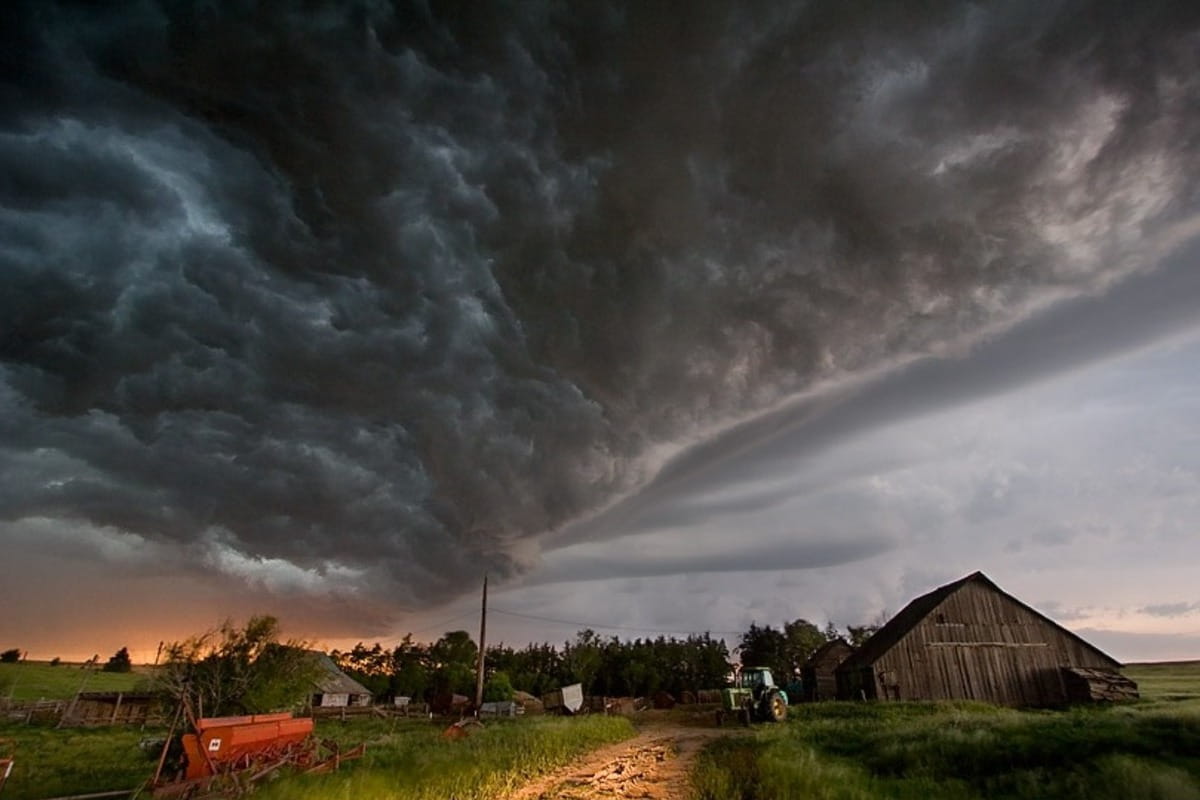
When clouds gather on the horizon and air temperature shifts unexpectedly we often witness an invisible battle of air masses unfolding above our heads. Atmospheric fronts represent dynamic boundaries between different air masses that govern Earth’s weather with unpredictable force and remarkable precision. You might not know that these invisible collision lines determine whether tomorrow brings sunshine or torrential rain whether wind carries warmth or sudden cold. Amazing facts about atmospheric fronts will reveal the complex machinery of our planet’s weather where every single degree of temperature difference can trigger a chain of events affecting thousands of kilometers of territory. Fascinating facts about these aerial boundaries will help you understand how our planet’s atmosphere operates and why weather forecasting often becomes a genuine scientific puzzle.
- An atmospheric front forms at the boundary where two air masses with different temperatures humidity levels and densities collide creating complex meteorological processes. Warm air always rises above cold air due to its lower density establishing conditions favorable for cloud formation and precipitation. This upward movement of warm air serves as the fundamental mechanism behind most weather phenomena we observe at Earth’s surface.
- A cold front develops when a mass of cold air advances forward displacing warm air which rapidly ascends upward. This process triggers intense formation of cumulonimbus clouds often accompanied by thunderstorms strong winds and brief but heavy precipitation. Following a cold front’s passage observers experience a sharp temperature drop rising atmospheric pressure and clearing skies.
- A warm front forms when a warm air mass gradually advances over a region of cold air rising above it along a gentle slope. This process leads to progressive development of stratiform clouds that may produce prolonged drizzle and light precipitation lasting many hours or even days. After a warm front passes air temperature gradually increases while atmospheric pressure decreases.
- A stationary front emerges when neither air mass can displace the other causing the frontal zone to remain over one territory for an extended period. Such fronts frequently cause prolonged periods of poor weather with continuous precipitation fog and overcast skies. Stationary fronts prove especially dangerous in mountainous terrain where they can trigger extended rainfall leading to flooding and landslides.
- An occluded front forms when a faster cold front overtakes a slower warm front lifting the warm air completely away from Earth’s surface. This complex phenomenon often accompanies intense precipitation strong winds and abrupt weather changes. Occlusions characterize mature cyclones and frequently signal the conclusion of a weather system’s active phase.
- A frontal zone may extend thousands of kilometers horizontally yet possess vertical thickness of merely several kilometers. The most active portion of a front typically resides within the lower five kilometers of the atmosphere where primary interaction between air masses occurs. Precisely within this zone most clouds precipitation and other weather phenomena form that directly impact human life.
- The polar front stands as Earth’s most significant permanent atmospheric front separating cold polar air masses from warm temperate latitudes. This front continuously shifts depending on season moving southward during winter and northward during summer. Interaction between air masses within the polar front zone serves as the primary source of cyclones and anticyclones in temperate latitudes.
- The equatorial front also known as the intertropical convergence zone forms near the equator where northern and southern trade winds meet and rise upward. This zone features persistent cloudiness intense precipitation and high atmospheric humidity throughout the entire year. The equatorial front’s position shifts following the sun determining seasonal rainfall patterns in tropical regions.
- Atmospheric fronts often display wavy structures with bends called frontal waves which serve as embryos for future cyclones. When a frontal wave deepens it may detach from the main front forming an independent cyclonic system. This process known as cyclogenesis represents the key mechanism for developing significant weather systems in temperate latitudes.
- The movement speed of an atmospheric front depends on temperature differences between air masses and wind strength in upper atmospheric layers. Cold fronts typically travel faster than warm fronts at speeds ranging from thirty to fifty kilometers per hour while warm fronts advance more slowly at ten to twenty kilometers per hour. In mountainous terrain fronts may stall or even fragment into separate segments.
- The frontal surface is never vertical but always inclined toward the cold air at an angle between one and two degrees. This slight inclination holds great significance for weather forecasting as it determines the frontal zone’s area of influence on Earth’s surface. The greater the frontal surface’s inclination the narrower the zone of intense precipitation though the stronger these precipitation events may become.
- Atmospheric fronts can trigger diverse optical phenomena in the atmosphere including rainbows sun pillars and halos around the sun or moon. These phenomena arise through light interaction with water droplets or ice crystals within clouds forming along the frontal zone. Observing such phenomena often helps experienced meteorologists predict a front’s approach even before receiving data from weather stations.
- Upper fronts exist in higher atmospheric layers that lack surface representation yet influence weather system development. These fronts form at altitudes between five and twelve kilometers and frequently determine the direction and intensity of jet streams. Studying upper fronts enables meteorologists to produce more accurate long-term weather forecasts.
- Frontal activity varies significantly across different world regions depending on geographical location and season. Over oceans fronts typically appear more pronounced and deliver more intense precipitation than over continents due to greater atmospheric moisture content. In tropical regions frontal activity remains weakly expressed whereas in temperate latitudes it serves as the primary weather formation mechanism.
- Atmospheric fronts can affect human health particularly for individuals suffering from meteorosensitivity or cardiovascular conditions. Sudden changes in atmospheric pressure temperature and humidity associated with frontal passages often trigger deterioration in wellbeing headaches and other symptoms. People with heightened meteorological sensitivity are advised to monitor frontal activity forecasts and take preventive measures.
- Modern meteorological satellites enable real-time observation of atmospheric fronts even over oceans where ground-based weather stations are absent. Infrared and water vapor channels on satellites allow visualization of frontal zones based on cloud temperatures and atmospheric moisture content. These data prove critically important for accurate weather forecasting especially for storm systems developing over oceans.
- Frontal systems play a crucial role in Earth’s global heat redistribution transporting thermal energy from equatorial regions toward polar latitudes. This process represents one of the fundamental mechanisms regulating Earth’s climate and maintaining the planet’s thermal balance. Without atmospheric fronts climatic differences between the equator and poles would be far more extreme.
- Atmospheric fronts can interact with terrain features producing local weather anomalies. When a front encounters mountains it may split bypass the obstacle or rise above it causing intense precipitation on the windward slope and dry conditions on the leeward side. This effect frequently appears in mountainous regions where one valley may lie shrouded in fog while another basks in sunlight.
- Polar latitudes feature special front types associated with Arctic and temperate air interaction known as Arctic fronts. These fronts exhibit extremely sharp temperature contrasts leading to highly intense weather phenomena. Arctic front passage often accompanies sudden temperature drops of twenty degrees or more within just several hours.
- Atmospheric fronts can influence urban air quality by concentrating pollutants along the frontal zone. When a warm front approaches a city polluted air may rise upward temporarily improving surface air quality. Conversely during cold front passage pollutants may compress toward the surface causing air quality deterioration.
- Studying atmospheric fronts holds vital importance for aviation since frontal zones frequently accompany turbulence aircraft icing and other hazardous conditions. Pilots receive specialized frontal activity forecasts and often alter flight paths to avoid dangerous zones. Modern turbulence warning systems rely significantly on atmospheric front behavior models.
These fascinating facts merely begin to unveil the complexity and significance of atmospheric fronts that shape daily weather above our heads. Each front stands as living testimony to the continuous movement and interaction of air masses that sustain our planet’s habitability. We hope these remarkable revelations will inspire you to view clouds above with fresh appreciation recognizing how much dynamism and energy lies hidden behind ordinary weather changes.


