
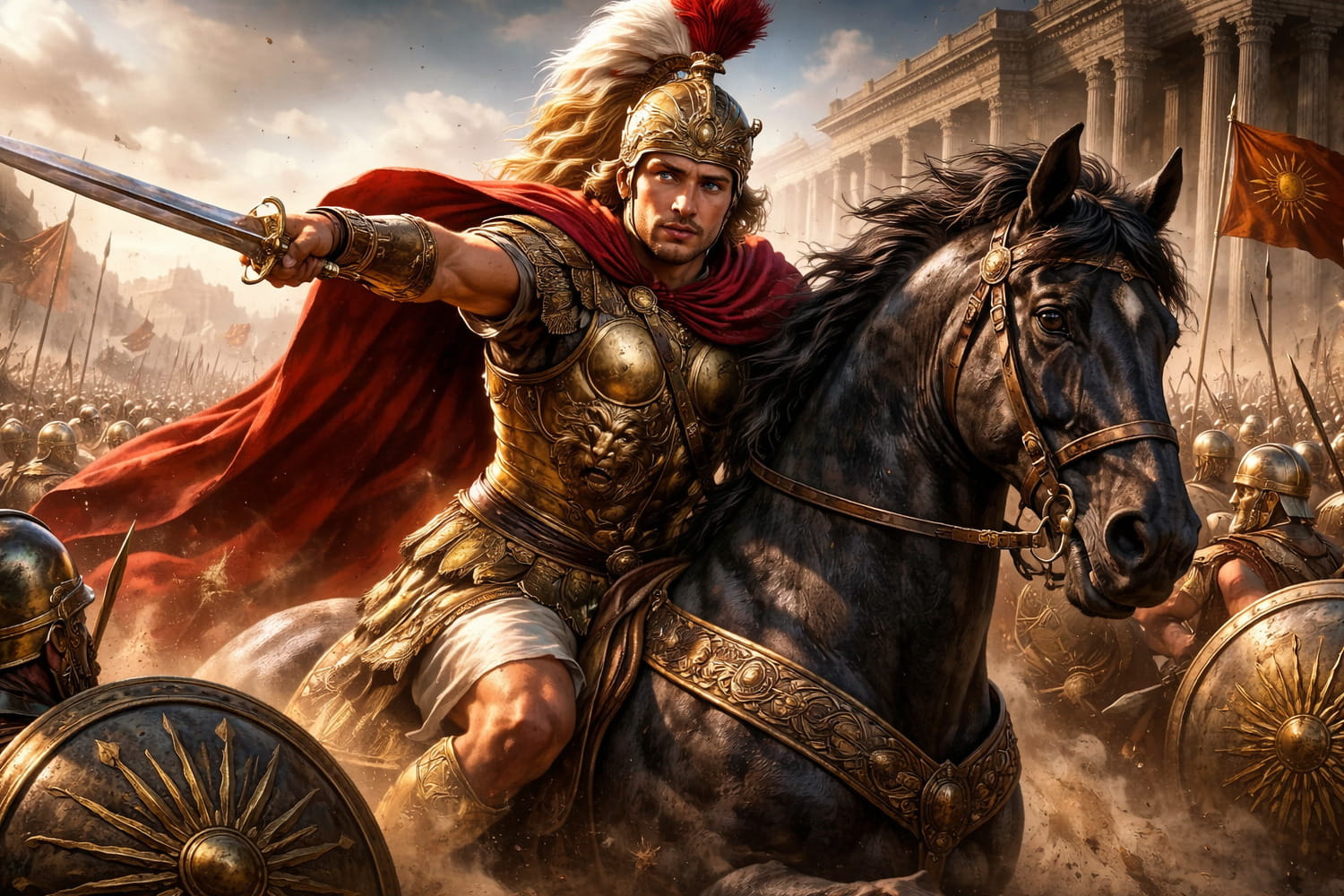
Imagine a twenty-year-old young man who ascends to the throne of a powerful kingdom and in just thirteen years creates the largest empire of the ancient world. His name resonates as a symbol of invincibility and boundless ambition throughout human history. Today we invite you to discover incredible facts about this legendary commander that you might not have known. These fascinating details will reveal not only a military genius but also a complex, multifaceted personality whose influence on world history is difficult to overestimate.
- Alexander the Great was born in the autumn of 356 BCE in Pella, the capital of Macedonia. He was the son of the powerful king Philip II and the Epirote princess Olympias, who was known for her strong-willed and ambitious nature. From early childhood, the future conqueror was surrounded by an atmosphere of political intrigue and military glory. His father Philip II implemented a series of important military reforms that became the foundation for his son’s future victories.
- At the age of twelve, Alexander tamed the unruly horse Bucephalus, whom adult warriors did not dare to mount. The boy noticed that the horse was frightened by its own shadow and turned it to face the sun. This event so impressed Philip II that he wept with pride and said that his son had found a kingdom, for Macedonia was too small for him. Bucephalus became Alexander’s favorite horse and accompanied him all the way to India.
- The greatest philosopher of antiquity, Aristotle, became Alexander’s personal tutor when the boy was thirteen years old. Philip II specifically invited Aristotle to educate his son, providing him with the temple complex in Mieza. Aristotle taught the future king rhetoric, logic, natural sciences, ethics, and politics. This knowledge significantly influenced Alexander’s approach to governing conquered territories and his desire to unite Greek and Eastern cultures.
- Alexander became king of Macedonia at the age of twenty after his father Philip II was assassinated during a wedding celebration. The young ruler immediately eliminated potential rivals, including relatives on his mother’s side. Just a few months after ascending the throne, he suppressed a rebellion in Greece by completely destroying the city of Thebes. This harsh demonstration of power forced the Greek city-states to recognize him as the hegemon of the Corinthian League.
- Alexander won his first significant military victory even before ascending the throne, when he was only eighteen years old. He commanded the cavalry during the Battle of Chaeronea against the combined forces of Athens and Thebes. His tactical maneuver helped the Macedonian army achieve a decisive victory over the Greeks. This battle became Philip II’s last great victory and demonstrated young Alexander’s talent as a military commander.
- Alexander the Great founded more than seventy cities, most of which bore his name—Alexandria. The most famous of them became Alexandria in Egypt, which transformed into one of the most important cultural centers of the ancient world. He named one city after his beloved horse Bucephalus following the horse’s death during the Indian campaign. These cities became strongholds for the spread of Greek culture and the Hellenization of the East.
- During the Indian campaign in 326 BCE, Alexander faced the powerful Indian ruler Porus in the Battle of the Hydaspes River. Despite the Indians using war elephants, the Macedonians achieved victory thanks to brilliant tactics. After the battle, Alexander asked the defeated Porus how he should be treated, and Porus replied as a king. Impressed by such an answer, Alexander not only allowed Porus to continue ruling his lands but also added new territories to them.
- Alexander the Great died in Babylon on June 13, 323 BCE at the age of only thirty-two. The cause of his premature death remains a mystery to historians and physicians. Among the theories are pancreatic necrosis, typhoid fever, Guillain-Barré syndrome, poisoning by white hellebore, or even ordinary malaria. His sudden death led to the collapse of the vast empire into several Hellenistic states.
- The body of the deceased commander was embalmed and placed in a golden sarcophagus filled with honey for preservation. Initially, the body was taken to the Egyptian city of Memphis, and later transferred to Alexandria. According to legend, Alexander wished to be buried in Siwa, a sacred oasis in the Libyan Desert, where he had visited the oracle of Ammon. However, his final resting place remains unknown, though most researchers believe the tomb is located somewhere in modern-day Alexandria.
- Alexander suffered from epilepsy, just like another great commander, Julius Caesar. Both of them were also born in July, adding an interesting coincidence to their biographies. Some historians suggest that epileptic seizures may have influenced his decisiveness and impulsiveness in decision-making. Despite this condition, he never lost control of his army during seizures.
- Alexander considered himself the son of the god Zeus-Ammon after visiting the oracle at Siwa. This belief in his divine origin strengthened after consulting with the oracle, which confirmed his connection to Zeus. He even began demanding that his entourage perform the Persian ritual of proskynesis, which caused discontent among the Macedonian nobility. This aspiration to divinity influenced his style of rule and relationships with his subjects.
- During his campaigns, Alexander never lost a single battle, despite often fighting against numerically superior forces. His tactical genius lay in the ability to quickly adapt to battlefield conditions and attack the enemy unexpectedly. He personally led the most important assaults, often risking his own life on the battlefield. This bravery inspired his soldiers and created the myth of his invincibility.
- Alexander sought to unite Greeks and Persians into a single empire, which caused resistance among the Macedonian nobility. He married Persian princesses Roxana, Stateira, and Parysatis to strengthen political alliances. Many Macedonians considered such actions a betrayal of Greek traditions. After his death, this policy was quickly abandoned by his successors.
- Alexander had heterochromia, meaning his eyes were of different colors. One eye was dark brown, while the other was reddish-blue, which added an air of mystique to his appearance. Contemporaries considered this feature a sign of divine origin. This characteristic was often depicted on coins and sculptures created during his lifetime.
- After the death of his closest friend Hephaestion, Alexander sank into deep grief and refused food for several days. He ordered mourning to be announced throughout the empire and commanded the construction of a monumental tomb for his friend. Some historians suggest that their relationship had a romantic character, which was acceptable in Greek culture of that time. The loss of Hephaestion became one of the greatest blows in Alexander’s life.
- Alexander possessed exceptional physical endurance and often traveled on horseback for several days without rest. During campaigns, he shared all hardships with his soldiers, drinking from the same sources and eating the same food. This created unwavering loyalty of the army to their leader, even when they found themselves in the most difficult conditions. His ability to withstand extreme loads amazed even his contemporaries.
- During the conquest of the Persian Empire, Alexander did not destroy Persepolis, the Persian capital, immediately after capturing the city. He ordered the preservation of royal archives and treasures, demonstrating respect for Persian culture. Only several months later, during a celebration, was the city burned down, and there are versions that this happened accidentally or by Alexander’s order as revenge for the burning of Athens by the Persians. This event remains one of the most controversial in his biography.
- Alexander was an excellent orator and masterfully used words to raise the morale of his army. Before each major battle, he delivered speeches that inspired soldiers to heroic deeds. He could speak in different languages, including Greek, Macedonian, and partially Persian, which helped him communicate with various peoples of his empire. His speeches are often mentioned in ancient sources as examples of military rhetoric.
You might not know that Alexander the Great’s legacy influenced the shaping of the world far more than his own empire. The Hellenistic culture he spread from the Mediterranean to India became a bridge between East and West for centuries to come. These incredible facts remind us that history is often shaped not only by victories but also by the ambitions, dreams, and human weaknesses of great rulers.


