
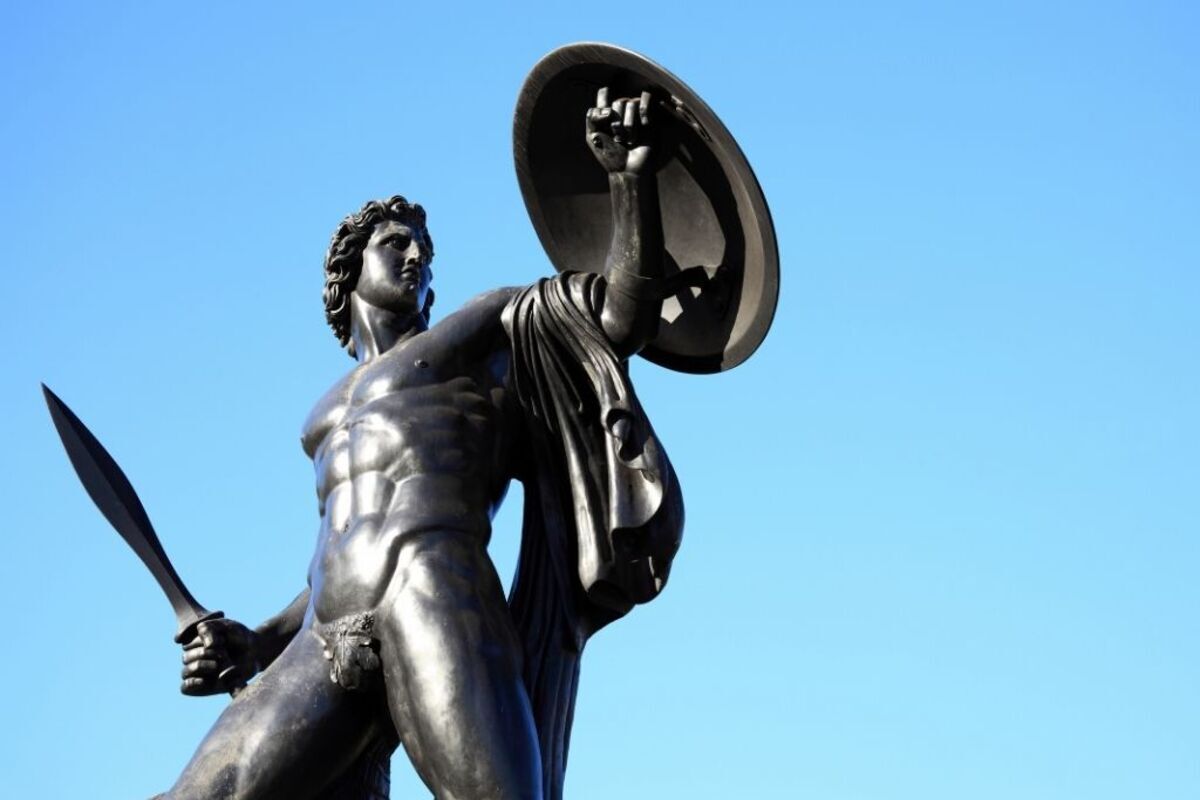
Achilles is one of the most famous heroes of ancient Greek mythology, about whom you may not have known countless fascinating details. This legendary warrior embodied the ideal of heroism, courage, and tragic fate in ancient culture. From his supernatural birth to his legendary participation in the Trojan War, the story of Achilles is filled with incredible events and symbolic moments. His image has inspired poets, artists, and philosophers for millennia and remains relevant to this day. Discover the most interesting facts about this greatest of Greek heroes.
- Achilles was the son of the mortal king Peleus and the sea goddess Thetis, which made him a demigod. According to legend, Thetis tried to make her son immortal by dipping him as an infant into the waters of the sacred river Styx. However, she held the baby by his heel, which remained vulnerable and later became the cause of his death.
- Achilles’ mother knew from prophecy that her son could choose one of two fates: a long peaceful life in obscurity or a short but glorious life as a hero. Thetis tried to protect her son from war by dressing him in women’s clothing and hiding him at the court of King Lycomedes. The cunning Odysseus exposed Achilles by laying weapons and jewelry before the disguised maidens, and the young man instinctively reached for the sword.
- Achilles received his education from the wise centaur Chiron, who raised many Greek heroes. Chiron taught him the art of war, music, medicine, and morality. It was thanks to this upbringing that Achilles became not only the best warrior but also an educated person capable of playing the lyre and composing songs.
- In Homer’s poem “The Iliad,” Achilles is portrayed as the best warrior of the Greek army at Troy. His indignation over the insult from Agamemnon, who took his captive Briseis from him, becomes the central theme of the epic. Achilles’ refusal to participate in battles led to severe defeats for the Greeks and the death of his best friend Patroclus.
- The friendship between Achilles and Patroclus is one of the most famous examples of brotherhood in ancient literature. After Patroclus’ death at the hands of the Trojan prince Hector, Achilles experienced unrestrained anger and grief. He returned to battle solely for revenge and killed Hector in a duel, then dragged his body behind a chariot around the walls of Troy.
- Achilles possessed divine armor crafted by the god-blacksmith Hephaestus himself at Thetis’ request. His shield was particularly famous, on which Hephaestus depicted the entire universe: sky, earth, sea, cities in peace and war. Homer devoted about 150 lines of his poem to describing this shield, making it a true work of art.
- According to legend, Achilles died from an arrow shot by the Trojan prince Paris, which was directed by the god Apollo. The arrow struck the hero’s only vulnerable spot: his heel. It is from Achilles’ name that the medical term “Achilles tendon” originates, connecting the calf muscles to the heel bone.
- Achilles had a son named Neoptolemus, also called Pyrrhus, by Deidamia, the daughter of King Lycomedes. Neoptolemus was born when Achilles was hiding at court in female disguise. After his father’s death, Neoptolemus came to Troy and played an important role in capturing the city with the help of the Trojan horse.
- Before the Trojan War, Achilles married Princess Deidamia on the island of Scyros, although some sources claim it was only a temporary liaison. Later, already at Troy, he was promised Polyxena, daughter of the Trojan king Priam, as a wife. According to one version of the myth, Achilles died precisely during negotiations about this marriage, falling into an ambush.
- Achilles was known for his superhuman speed, for which he was called “swift-footed.” The Iliad repeatedly describes how he caught up with enemies from whom other warriors could not escape. His speed was considered a gift from the gods and was one of his key advantages in battles.
- According to some versions of the myth, after death Achilles’ soul was transferred to the Islands of the Blessed or the White Island in the Black Sea. There he continued his existence as an immortal hero, marrying Medea or the beautiful Iphigenia. Ancient Greeks even created sanctuaries in his honor on the coast of the Black Sea.
- Achilles was known not only for his ferocity in battle but also for his capacity for magnanimity. When the old king Priam came to him to ransom the body of his son Hector, Achilles was moved by his grief. He returned the body for burial and declared a truce so that the Trojans could properly bury their hero.
- In ancient Greek culture there existed a cult of Achilles, especially in the cities of the northern Black Sea coast. Temples were dedicated to him, sacrifices were offered, and athletic competitions were held in his honor. In Sparta, young men offered him sacrifices before battles, considering him a model of martial valor.
- The image of Achilles has inspired countless artists, sculptors, and writers throughout millennia. From ancient vases to Renaissance paintings, from the tragedies of Aeschylus to modern novels and films, the story of this hero is constantly reinterpreted. Philosophers used him as an example to discuss themes of honor, anger, and human destiny.
- Achilles owned two immortal horses named Xanthus and Balius, which were gifts from the gods. According to legend, the horses could speak, and once Xanthus prophesied Achilles’ swift death. These divine horses were so fast they could outrun the wind, and they mourned their master after his death.
- The wrath of Achilles is the central theme of “The Iliad,” and even the poem’s first words are “Sing, goddess, the wrath of Achilles.” This wrath was first directed against Agamemnon for insulting his honor, then transformed into a thirst for revenge after Patroclus’ death. Homer shows how the hero’s uncontrolled anger leads to tragic consequences for many people.
Achilles remains one of the most multifaceted and tragic characters in world mythology, whose story continues to stir people’s hearts. Incredible facts about this hero reveal the complexity of human nature, the conflict between glory and happiness, between duty and personal feelings. His image has become an eternal symbol of heroism, but also a reminder of the price one must pay for greatness, of the vulnerability even of the strongest, and of the inevitability of fate.


