
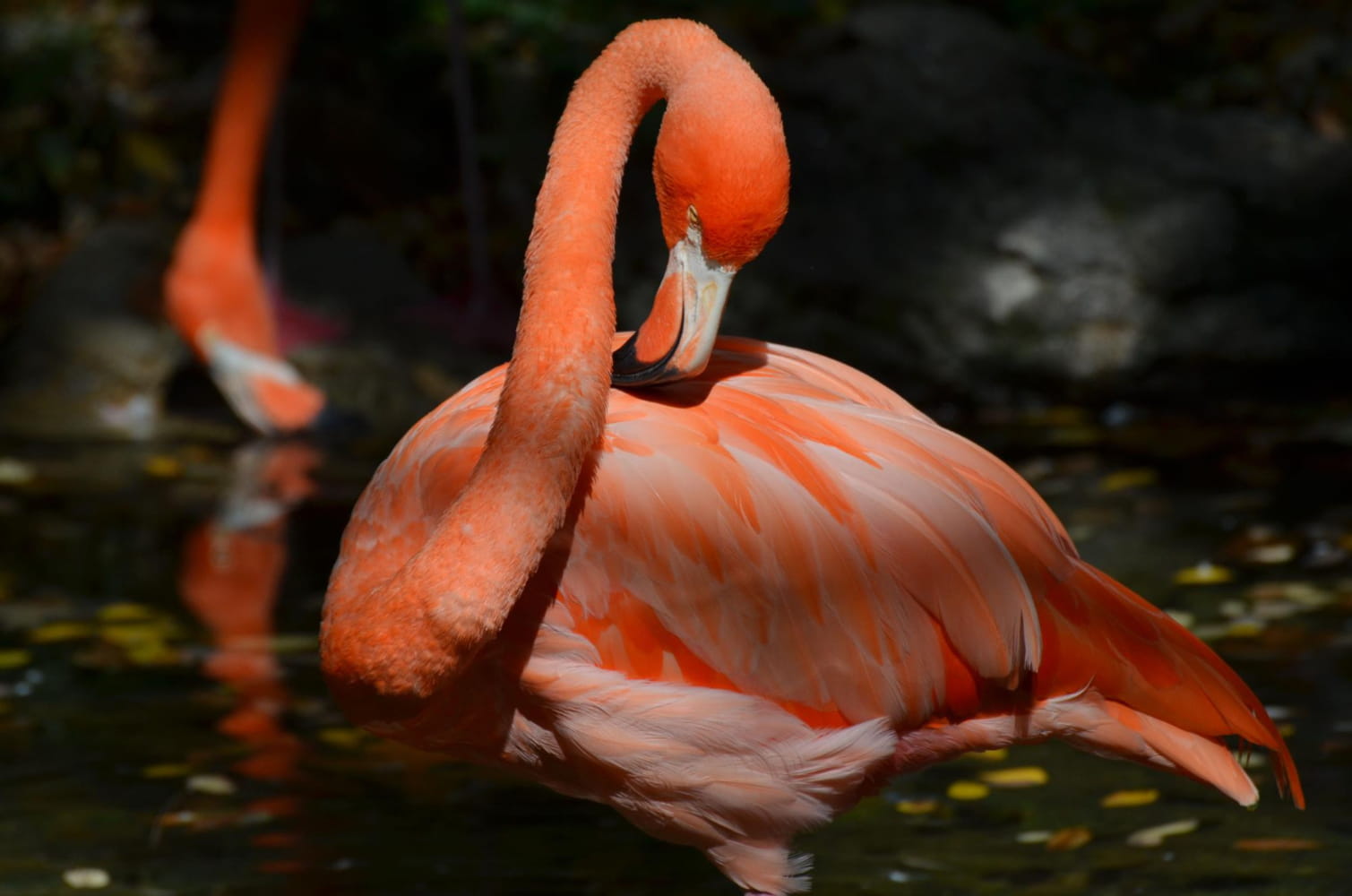
These elegant pink birds with long legs and curved beaks capture attention with their unusual beauty and fascinating behavior. Many people consider flamingos to be simply beautiful creatures, but in reality they hide numerous amazing features that make them one of the most extraordinary birds on Earth. They inhabit the most extreme water reservoirs in the world, where most other animals would not be able to survive. Today we will reveal incredible facts about flamingos that will forever change your perspective on these captivating creatures. You might not have known how complex and perfect their world is, hidden behind that pink charm.
- The pink color of flamingos is not innate but depends entirely on their diet. These birds consume enormous amounts of crustaceans, algae, and other organisms containing carotenoids. These pigments gradually accumulate in their feathers, giving them their characteristic pink or even intensely red hue. When a flamingo receives an insufficient amount of these substances, its plumage becomes pale or even white.
- Newly hatched flamingo chicks look completely different from adult individuals. They appear in the world covered in gray or white down with a straight beak. Only over time, when they begin to consume an adult diet, do their feathers acquire the characteristic pink shade. The beak also gradually curves into the typical flamingo shape during the first months of life.
- Flamingos possess an exceptional ability to drink water at extremely high temperatures. They can drink water heated almost to boiling point without any harm to their health. This adaptation allows them to survive near hot springs and volcanic lakes in African savannas. Their organism has adapted to such extreme conditions thanks to the special structure of their beak and throat.
- To remove excess salt from their bodies, flamingos have special salt glands located above their eyes. These glands work actively when the bird consumes salty water or food with high salt content. The excess salt is excreted through the nostrils in the form of a concentrated solution. This is why sometimes you can observe flamingos gently shaking their heads to get rid of this solution.
- During the mating season, flamingos organize true collective dances that amaze with their synchronization. Thousands of birds simultaneously lift their legs, turn their heads, and move in perfect unison. Such rituals help in forming pairs and strengthening bonds within the colony. This is one of the most impressive examples of social behavior among birds.
- Both parents participate in feeding the chicks with a special substance called bird milk. This thick liquid is produced in the crop of adult birds thanks to hormonal changes during incubation. It is rich in proteins, fats, and antibodies necessary for the chick’s growth and immune system development. This feeding mechanism resembles milk feeding in mammals, although it is not evolutionarily related to it.
- Flamingos build their nests in the shape of cone-shaped mounds made of mud and vegetation. The height of such a nest can reach half a meter, which protects the egg from flooding when the water level rises. A small depression is created at the top of the cone for the egg. This construction represents a brilliant adaptation to life in unpredictable water reservoirs.
- While feeding, flamingos turn their heads upside down, submerging their beaks in water. They move their beaks from side to side, filtering water through special plates located along the edges. These plates trap small crustaceans, insects, and algae, which form the basis of their diet. This feeding method makes them efficient filters of water reservoirs.
- Flamingos can stand on one leg for hours, even during sleep. This ability results from the unique structure of their leg joints, which lock in a bent position without additional muscular effort. Such a posture helps maintain body heat, as one leg hides in the feathers while the other contacts cold water. Additionally, this reduces muscle strain during prolonged standing.
- The real knees of flamingos are hidden under feathers near the torso, and what we perceive as a knee is actually the ankle joint. This anatomical feature allows them to have exceptionally long legs necessary for walking through deep water. The legs move forward thanks to the work of the real knees, which are almost invisible under the plumage. Such construction represents a key adaptation to an aquatic lifestyle.
- Flamingos are exceptionally social birds that almost never live alone. They form colonies ranging from several hundred to millions of individuals. Such numbers provide better protection from predators and increase the chances of successful reproduction. Large colonies create an impressive sight, especially during simultaneous takeoff or landing.
- During flight, flamingos stretch their necks straight forward, unlike many other water birds. They also keep their legs straight behind them, creating a characteristic silhouette in the air. Flight speed can reach sixty kilometers per hour, and flight altitude sometimes exceeds five thousand meters. To take off, they need to run along the water surface while actively flapping their wings.
- In the wild, flamingos can live more than forty years, making them one of the longest-living birds. In captivity, individual specimens have lived over eighty years with proper care. Longevity is connected to their social organization and ability to avoid predators in large colonies. Such a long lifespan allows them to reproduce multiple times throughout their lives.
- Flamingos lay only one egg per breeding season, which makes each chick extremely valuable to the colony. Incubation lasts about a month, and both parents take turns sitting on the egg. The chick hatches already able to stand and walk, though it still needs parental care. This strategy ensures maximum attention devoted to the single offspring.
- There are six different species of flamingos, which differ in size, color, and range of distribution. The largest is the greater flamingo, which can reach one and a half meters in height. The smallest is considered the lesser flamingo, whose height rarely exceeds ninety centimeters. Representatives of different species inhabit four continents, avoiding only Antarctica and Australia.
- Flamingos possess an extremely loud voice resembling the honking of geese or ducks. They actively communicate with each other using various sounds during flight, feeding, and mating rituals. These sounds help maintain contact in large colonies and coordinate joint actions. Even chicks in the nest produce characteristic sounds to attract their parents’ attention.
- To defend territory and protect against predators, flamingos use their long legs as an effective weapon. They can deliver powerful kicks capable of driving away even medium-sized predators. Additionally, the colonial lifestyle creates a collective protection effect. Many eyes and ears allow for early detection of danger and an organized response.
- Flamingos can drink water with an extremely high salt concentration that most other animals could not withstand. Their organism has adapted to life in salt lakes thanks to the efficient work of salt glands. This adaptation allows them to colonize water reservoirs where competition for food is minimal. Such conditions become an ideal living environment for them.
- During mass migrations, flamingos create captivating flying formations resembling pink clouds in the sky. They can cover distances of up to one thousand kilometers in search of more favorable conditions. Such flights occur mainly at night to avoid overheating and predators. Navigation during migrations is based on instincts and probably on orientation by stars.
These fascinating facts about flamingos only partially reveal the complexity and perfection of these extraordinary birds. Their world still hides many mysteries that continue to amaze scientists and ordinary nature observers. Observing flamingos provides us with a reminder of the astonishing richness of life on our planet and how precisely organisms adapt to their ecological niche. Incredible discoveries related to these birds inspire us to care for their environment for future generations.


