
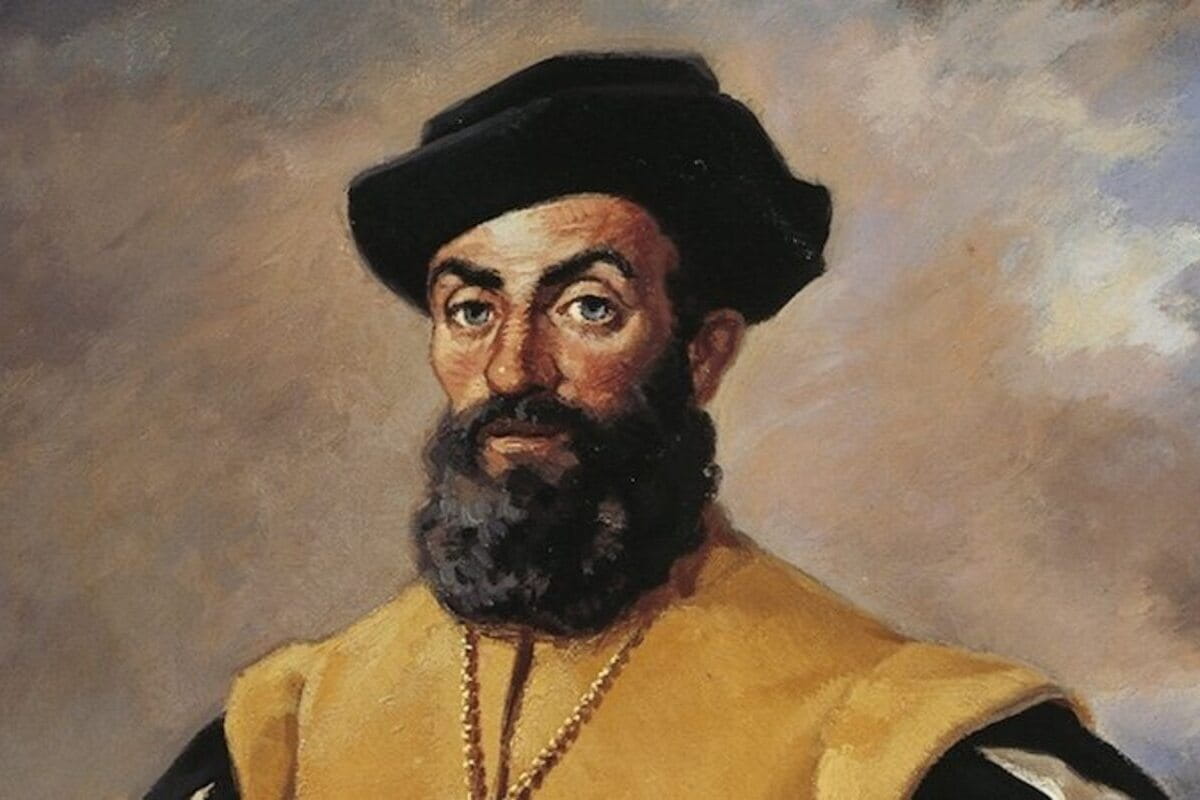
Ferdinand Magellan is a legendary Portuguese navigator whose name is forever inscribed in the history of great geographical discoveries. It was his expedition that first completed a circumnavigation of the globe, proving that the Earth has a spherical shape and that all oceans are connected to each other. Although Magellan himself did not complete this epic journey, his courage, perseverance, and navigational genius changed humanity’s understanding of our planet. Much of what you may not have known about this outstanding explorer reveals not only his professional achievements but also the dramatic circumstances of his life and death. We present to your attention a collection of fascinating facts about Ferdinand Magellan that will allow you to more deeply understand the scale of his contribution to world history.
- Ferdinand Magellan was born approximately in 1480 in the Portuguese town of Sabrosa into a family of impoverished nobles. His full name in Portuguese was Fernão de Magalhães, and in Spanish, under which he entered history, Fernando de Magallanes. His origin from a noble family allowed him to receive education at the royal court, where he studied navigation, astronomy, and cartography. It was this knowledge that later became the foundation for his greatest achievements as a navigator.
- Before his famous expedition, Magellan participated in numerous Portuguese maritime campaigns to India and Africa. He served under the command of Francisco de Almeida, the first Portuguese viceroy of India, and participated in the Battle of Diu in 1509. During his service in Morocco in 1513, Magellan received a leg wound that left him lame for the rest of his life. This injury did not break his spirit, but became the cause of conflicts with the Portuguese king, who accused him of illegal trade with the Moors.
- After the Portuguese King Manuel I refused to support Magellan’s plan to find a western route to the Spice Islands, the navigator transferred to Spanish service. In 1517 he arrived in Seville and received Spanish citizenship, changing his name to the Spanish manner. King Charles I of Spain, who later became Emperor Charles V of the Holy Roman Empire, supported Magellan’s ambitious plan. This transfer to Spanish service caused outrage in Portugal and made Magellan a traitor in the eyes of his compatriots.
- Magellan’s expedition began on September 20, 1519, from the Spanish port of Sanlúcar de Barrameda with a fleet of five ships. The flagship was called “Trinidad,” and the other vessels bore the names “San Antonio,” “Concepción,” “Victoria,” and “Santiago.” The total crew numbered about 270 people of different nationalities, including Spaniards, Portuguese, Italians, French, and Greeks. The multinational composition of the crew became one of the sources of conflicts during the voyage.
- Magellan discovered the strait connecting the Atlantic and Pacific Oceans, which now bears his name – the Strait of Magellan. The search for this passage lasted almost a month, and the expedition explored every bay along the South American coast. The strait proved extremely dangerous for navigation with its narrow passages, strong currents, and unpredictable weather. During the passage through the strait, one ship, “Santiago,” was wrecked during a reconnaissance mission, and the captain of “San Antonio” deserted and returned to Spain with part of the supplies.
- The name “Pacific Ocean” was given by Magellan himself, amazed by the calm waters after the turbulent Strait of Magellan. When the fleet entered the unknown ocean in November 1520, the sea proved so quiet and calm that Magellan called it “Mar Pacifico,” which means “peaceful sea.” In reality, the expedition was simply fortunate with the weather, as the Pacific Ocean can be very stormy. This name has been preserved to this day as the official name of the planet’s largest ocean.
- Crossing the Pacific Ocean took Magellan more than three months, during which the expedition saw no land. The journey across the ocean proved much longer than Magellan expected, as he underestimated the size of the Pacific Ocean. The crew suffered from scurvy, hunger, and thirst, sailors were forced to eat leather belts, gnaw wooden parts of the ship, and catch rats. According to various estimates, during this passage about twenty crew members died from hunger and disease.
- On March 6, 1521, Magellan’s expedition reached islands that he called the Ladrones because the local inhabitants stole one of the boats. These islands are now known as the Mariana Islands and are part of Micronesia. The meeting with the local population began with conflict, and Magellan ordered several houses burned and seven local residents killed in response to the theft. Despite the conflict, the crew was able to replenish supplies of fresh food and water, which saved many from inevitable death.
- Magellan had his own slave named Enrique, whom he acquired during his previous voyages to the Malay Archipelago. Enrique became the first person in history who actually circumnavigated the globe, as he returned to the region of his birth. When the expedition reached the Philippines, Enrique could communicate with the local inhabitants in their language, which made him an invaluable interpreter. Some historians believe that it is Enrique who should be considered the first traveler to complete a true circumnavigation, rather than the crew members who returned to Spain.
- On April 27, 1521, Ferdinand Magellan died in battle on the island of Mactan in the Philippines, defending the local ruler Humabon. Magellan decided to intervene in a local conflict between two Filipino chieftains, supporting the one who had accepted Christianity. Chief Lapu-Lapu refused to recognize Spanish authority and met Magellan and his men with armed resistance. During the battle in shallow water, Magellan was wounded by a poisoned arrow and then beaten to death by numerous opponents who attacked him with spears and swords.
- After Magellan’s death, the expedition was led by Juan Sebastián Elcano, a Basque navigator who completed the circumnavigation. Of the five ships that departed from Spain, only one – “Victoria” – managed to return home on September 6, 1522. Only 18 exhausted sailors remained on board from the initial 270 crew members. Despite the enormous losses, the expedition brought back so many spices that their sale covered all the costs of the voyage and even brought profit.
- Magellan never learned that his expedition proved the sphericity of the Earth and the possibility of circumnavigating it by sea. He died when more than a year of sailing remained until the completion of the voyage. However, it was his navigational genius, courage, and perseverance that made this journey possible. Historians debate whether Magellan should be considered the one who accomplished the first circumnavigation, since he did not complete it personally, but they recognize his key role in this achievement.
- Magellan’s expedition demonstrated for the first time the true scale of the Earth and the size of the Pacific Ocean. Before this voyage, Europeans could not imagine that the ocean lying between America and Asia was so enormous. Cartographers were forced to revise all existing maps and globes. The discovery was of enormous significance for the development of world trade, geology, navigation, and scientific understanding of our planet.
- The expedition’s journal was kept by the Italian scholar Antonio Pigafetta, who was one of the 18 sailors who returned to Spain on “Victoria.” His detailed records became the most important historical document about the first circumnavigation and include descriptions of previously unknown lands, peoples, animals, and plants. Pigafetta described hundreds of islands, documented fourteen different languages, and created dictionaries of some of them. Thanks to his notes, we know details not only about geographical discoveries but also about the daily life of sailors, their sufferings and conflicts.
- Magellan applied innovative navigation methods, including the use of sea charts and astrolabe to determine latitude. He was one of the first navigators who systematically conducted astronomical observations during sailing. Magellan also developed a signaling system for his ships to maintain fleet communication during long passages. His navigational records and maps became a valuable contribution to the maritime science of the 16th century.
- During the voyage, Magellan encountered several mutiny attempts among his officers and crew. The most serious mutiny occurred in April 1520 during wintering in San Julián Bay in Patagonia, when the captains of three ships raised a rebellion against his command. Magellan brutally suppressed the uprising, executing one of the leaders and leaving two others on shore when the expedition continued its way. These conflicts were caused by national tensions between the Portuguese and Spanish, as well as doubts about the success of the mission.
- Magellan was a deeply religious person and considered his mission not only geographical discoveries but also the spread of Christianity. He always carried priests and missionaries with him and tried to convert the local population to the Catholic faith everywhere his expedition stopped. In the Philippines, Magellan personally baptized the local ruler Humabon and about eight hundred of his subjects. It was his religious zeal that partially led to the conflict with Lapu-Lapu, who refused to accept the new faith and recognize Spanish authority.
- Not only the strait between mainland South America and Tierra del Fuego was named after Magellan, but also two dwarf satellite galaxies of the Milky Way. The Large and Small Magellanic Clouds are visible to the naked eye in the Southern Hemisphere and were described by European travelers precisely after Magellan’s expedition. In space, there is also the Magellan crater on the Moon and the “Magellan” spacecraft that explored Venus. These names emphasize recognition of his contribution to the exploration of the unknown.
- Magellan calculated that the Spice Islands (Moluccas) were located in the Spanish hemisphere according to the Treaty of Tordesillas of 1494. This treaty divided the world between Spain and Portugal along a demarcation line, but did not take into account that the Earth is round. Magellan’s expedition actually proved that the Moluccas were located in the Portuguese zone of influence if counted from the eastern direction. This geographical fact became the cause of lengthy diplomatic disputes between the two maritime powers.
- Magellan’s discovery of the western route to Asia had revolutionary significance for the world spice trade. Spices at that time were valued by weight in gold and were the main driving force of the age of great geographical discoveries. Although the route through the Strait of Magellan proved too long and dangerous for regular trade, it demonstrated the existence of an alternative to the Portuguese route around Africa. This competition between maritime routes stimulated further exploration of the oceans and the development of navigational technologies.
These incredible facts about Ferdinand Magellan reveal the image of an outstanding navigator who combined a scientific mind, indomitable will, and the religious fanaticism of his time. His expedition forever changed the geographical picture of the world and proved the unity of the World Ocean, although he himself did not live to see the triumphant completion of the voyage. Magellan’s legacy extends far beyond his personal achievements and symbolizes humanity’s tireless quest for knowledge of the unknown, regardless of the price of that knowledge.


