Greenland is far more than just the world’s largest island—it is a land of breathtaking extremes: eternal ice and lush fjords, ancient traditions and modern climate challenges. Despite its name, which translates to “green land,” most of the island is covered in ice, yet it is precisely this contrast that makes it so extraordinary. You may not have known that Greenland belongs to the Kingdom of Denmark but enjoys extensive self-rule, or that humans have lived here for over 4,500 years. Among countless fascinating details about this Arctic realm lie stories that reshape our understanding of the Far North. Here are some of the most captivating.
- Greenland is the largest island in the world, with a total area of approximately 2.16 million square kilometers. However, only about 410,000 square kilometers are free of permanent ice—less than fifteen percent of the entire territory. These ice-free zones are concentrated mainly along the coast, where nearly all of the population resides. The rest is dominated by the Greenland Ice Sheet, which in some places exceeds three kilometers in thickness.
- The name “Greenland” was coined by the exiled Norse explorer Erik the Red in the 10th century. He deliberately chose an appealing name to attract settlers to the island. Although the climate was slightly warmer during the Medieval Warm Period, much of the land was still ice-covered even then. His marketing strategy worked—soon afterward, Norse settlements appeared on the southwestern coast.
- Greenland is part of the Kingdom of Denmark but has held autonomous status since 1979. In 2009, an expanded self-government agreement granted Greenland control over most internal affairs, including the judicial system, police, and natural resources. However, foreign policy and defense remain under Danish authority. The island has its own parliament—Inatsisartut—and a prime minister.
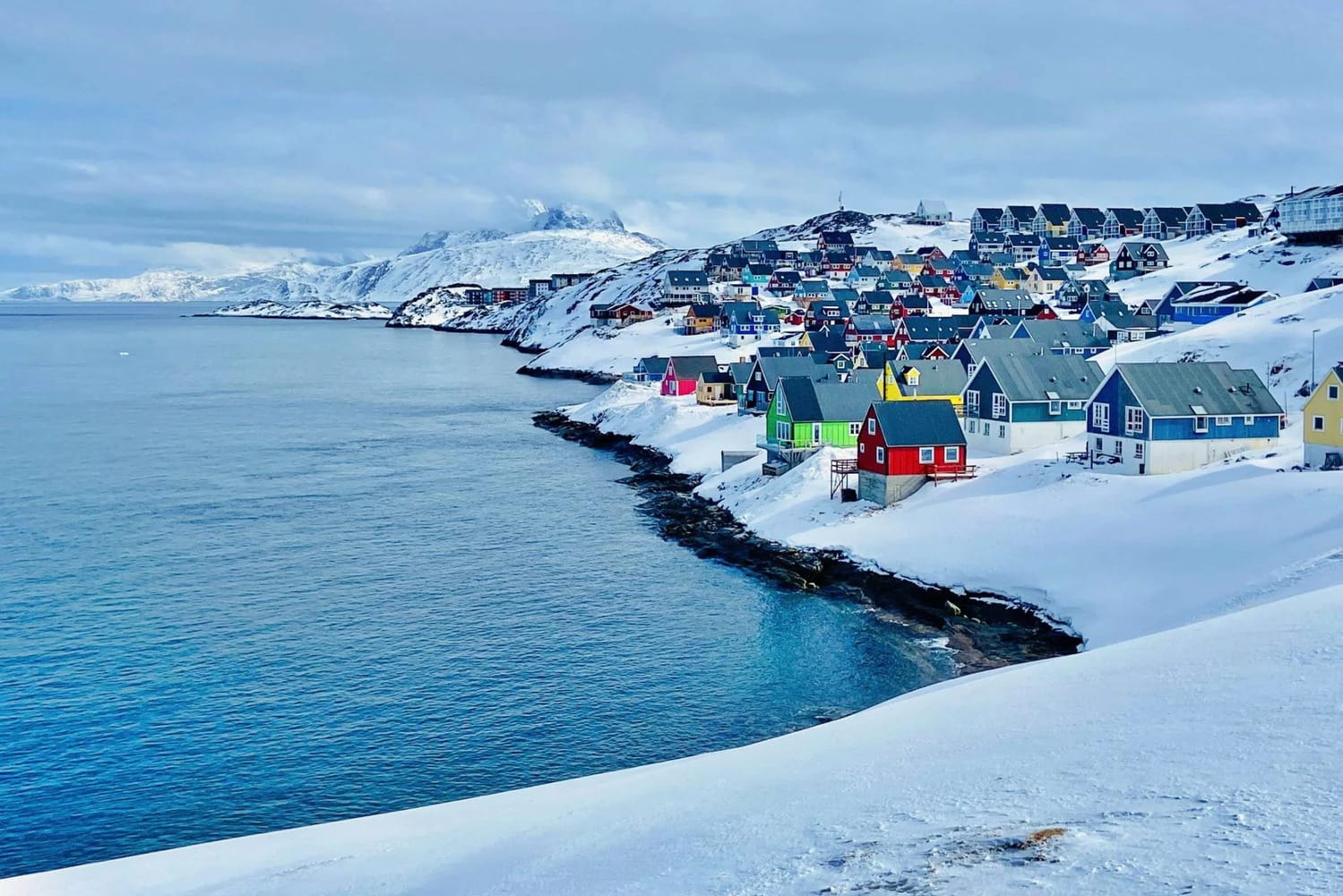
- Greenland’s population is only about 56,000 people, and the majority are Indigenous Inuit. They make up more than 85 percent of the population and continue to preserve their language, culture, and traditional way of life. Greenlandic (Kalaallisut) is the official language, though Danish is also widely used, especially in education and administration. Towns are small, and many communities are accessible only by air or sea.
- The Greenland Ice Sheet is the second-largest ice body in the world after Antarctica. If it were to melt entirely, global sea levels would rise by nearly seven meters. Today, the ice sheet is melting at an accelerating rate due to climate change, and scientists closely monitor this process. Ice loss not only affects global weather patterns but also reveals new opportunities for mineral exploration.
- The northernmost permanently inhabited settlement in the world is Qaanaaq, located in northern Greenland. It lies just 700 kilometers from the North Pole. Fewer than 300 people live there, relying on traditional hunting of walruses, narwhals, and polar bears. This remote outpost is considered one of the most isolated and inaccessible human settlements on Earth.
- There are no roads connecting towns in Greenland—all transportation occurs by air or sea. Aircraft and helicopters are the primary means of travel between communities, supplemented by boats in summer. In winter, when the sea freezes, some routes cross the ice. This makes logistics expensive but ensures connectivity even to the most distant villages.
- Greenland is one of the youngest inhabited regions in human history. The first people—Paleo-Inuit cultures—arrived around 2500 BCE. They were later succeeded by the Dorset and Thule cultures, from whom modern Inuit descend. Norse settlements established by Erik the Red thrived until the 15th century, after which they mysteriously disappeared, likely due to a combination of climate cooling and social factors.
- Greenland has no forests, but dwarf birch, willow, and other low-growing plants do exist. In summer, southern areas become surprisingly green thanks to mosses, lichens, and tundra vegetation. As the climate warms, actual trees are beginning to appear in some sheltered valleys—a visible sign of ongoing environmental change. This shift is gradually opening possibilities for limited agriculture.
- Greenland has one of the lowest population densities in the world—fewer than 0.03 people per square kilometer. This means the vast majority of its territory is completely uninhabited. Even in the capital, Nuuk, home to more than one-third of the island’s population, only about 19,000 people live. Such isolation fosters a unique lifestyle rooted in mutual support and deep respect for nature.
- A traditional Greenlandic dish called “kiviak” consists of fermented seabirds sealed inside a hollowed-out seal skin. Prepared over several months through natural fermentation, it is considered a delicacy, especially during celebrations. While it may seem exotic to outsiders, kiviak is a cherished part of cultural heritage. Such foods were essential for survival during long, dark Arctic winters.
- Greenland is a critical region for climate research. Scientific stations across the ice sheet extract ice cores that contain atmospheric data stretching back hundreds of thousands of years. These records help scientists understand historical climate patterns and predict future changes. Record-breaking surface melt events were observed across Greenland in both 2012 and 2019, underscoring the urgency of global warming.
- The world’s largest fjord system—Scoresby Sund (Kangertittivaq)—is located on Greenland’s east coast. Stretching over 350 kilometers inland and reaching widths of up to 40 kilometers, it is among the deepest fjords on Earth. Surrounded by towering mountains and active glaciers, it serves as a vital habitat for whales, seals, and rare seabirds, making it a key marine and terrestrial reserve.
These remarkable facts about Greenland reveal a land that is simultaneously primordial and contemporary, isolated yet globally significant. You may not have realized that beneath its icy vastness lies a resilient culture that has endured extreme conditions for millennia. These fascinating insights remind us that Greenland is not merely a dot on the map but a living entity—one that responds to every shift in Earth’s climate and holds irreplaceable memories of humanity’s past.


