
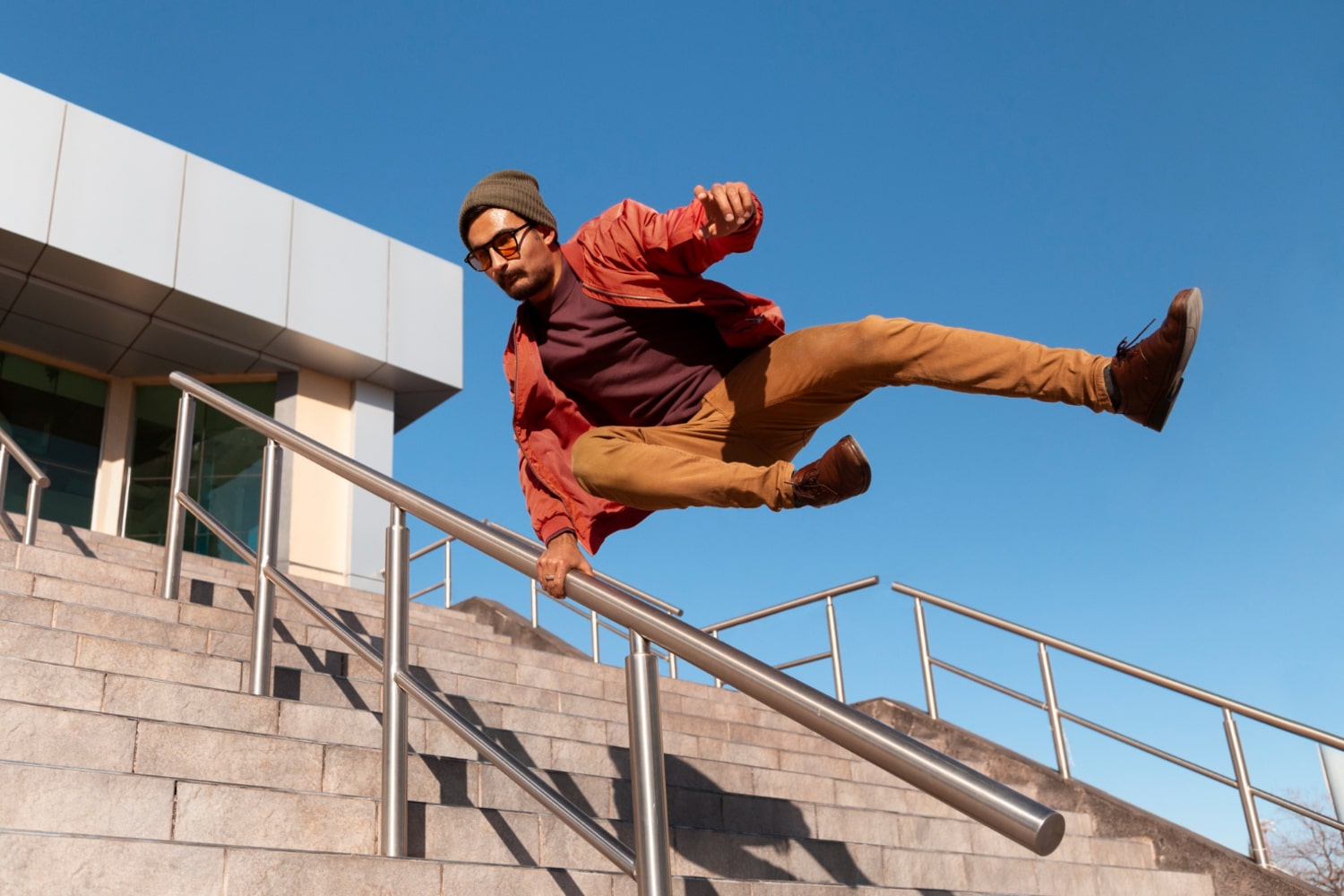
Parkour has long been more than just spectacular jumps across walls, railings, and rooftops. It represents a philosophy of movement that combines physical training, mental control, and a conscious relationship with one’s own body. Interesting facts about parkour reveal that behind dynamic videos lies a structured system of principles and values. Many incredible facts are connected not only with sport, but also with psychology, urban space, and personal development. These fascinating facts show that parkour is a discipline you may not fully understand at first glance.
- Parkour originated in France at the end of the twentieth century as a practical method of movement. Its roots are closely linked to military training focused on overcoming obstacles quickly and efficiently. The original purpose was to prepare the body for real-life situations in unpredictable environments. Over time, this approach evolved into an independent movement discipline.
- The word parkour comes from a French term meaning a route or path. This reflects the core idea of the discipline, where the goal is not a flashy trick but the most efficient way to move forward. Every movement is meant to be logical and fluid. This concept clearly distinguishes parkour from purely acrobatic activities.
- People who practice parkour are commonly called tracers. The term refers to someone who traces or creates a path. Within the community, it carries a deeper meaning than a simple label. A tracer learns to see obstacles as opportunities rather than limitations.
- Parkour does not rely on traditional competitions or formal contests. Many practitioners believe that competition contradicts the philosophy of the discipline. The main focus is personal progress rather than comparison with others. Training sessions are often built around cooperation and shared learning.
- Safety is one of the fundamental principles of parkour. Although it may appear dangerous from the outside, experienced tracers carefully analyze every movement. Training begins with basic techniques and gradually becomes more complex. This method significantly reduces the risk of injury.
- Parkour develops more than just muscular strength and endurance. Regular practice improves coordination, balance, and spatial awareness. Practitioners learn to adapt quickly to changing environments. These skills often prove useful in everyday life beyond training.
- No special equipment is required to practice parkour. Comfortable clothing and shoes with good grip are usually sufficient. This simplicity makes the discipline accessible to a wide range of people. Its low entry barrier has contributed greatly to its global popularity.
- Parkour is deeply connected to the urban environment. Stairs, walls, fences, and railings become elements of movement rather than obstacles. The city is transformed into a dynamic space instead of a static background. This perspective changes how people perceive their surroundings.
- The psychological aspect plays a crucial role in parkour. Tracers learn to manage fear and make conscious, responsible decisions. The discipline is not about reckless risk-taking but about understanding personal limits. Mental control often becomes the key factor in long-term progress.
- Parkour has had a noticeable influence on cinema and video games. Its movement style appears in many films and interactive projects. These elements add realism and intensity to action scenes. As a result, parkour has become part of popular culture.
- Over time, several related disciplines have emerged from parkour. One of the most well-known is freerunning, which places greater emphasis on visual expression and acrobatics. While the movements may look similar, the underlying philosophy differs. These distinctions are frequently discussed within the community.
- Parkour is often used as a method of physical development for children and young people. It encourages natural movement patterns without rigid structures. Children learn to better understand and trust their bodies. This approach supports balanced and healthy development.
- There are no strict age limits for practicing parkour. People of different ages adapt training intensity to their individual abilities. The most important principles are gradual progression and awareness. This allows parkour to remain a lifelong practice for many individuals.
Parkour is a phenomenon far deeper than it may seem at first glance. Fascinating facts demonstrate how it combines physical ability with mental resilience and creative thinking. Incredible facts show that movement itself can become a tool for self-discovery. These interesting facts help present parkour not only as a physical activity, but also as a conscious and meaningful way of life.


