
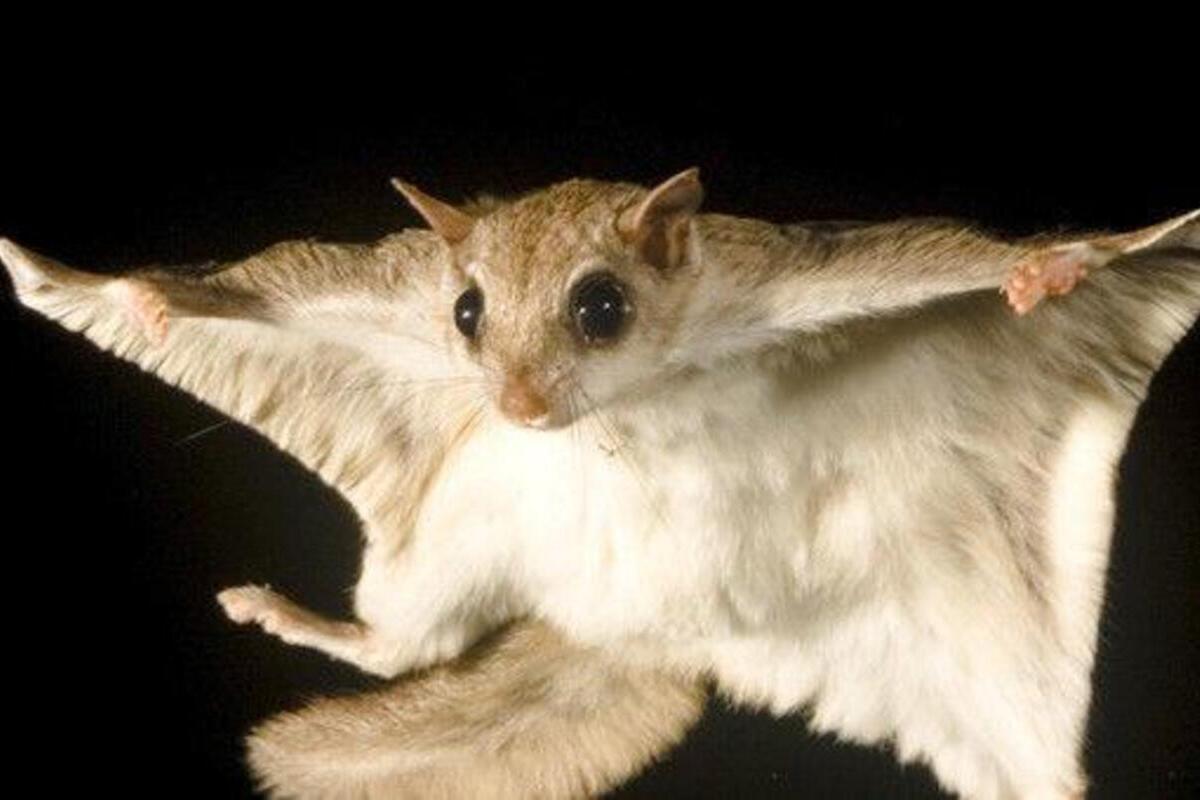
Flying squirrels are among those animals that immediately spark curiosity and genuine admiration. They combine the familiar image of a forest squirrel with an extraordinary ability to glide silently between trees. Interesting facts about flying squirrels reveal a hidden world of nocturnal movement, refined evolutionary adaptations, and life high in the forest canopy. Fascinating facts show that even in seemingly well-known ecosystems, nature still holds remarkable surprises. You may not know that people rarely encounter flying squirrels because most of their activity happens out of sight after sunset.
- Flying squirrels do not truly fly but glide through the air. A special skin membrane stretches between their front and hind legs. When they leap, this membrane opens and functions like a wing. It allows them to move efficiently from one tree to another.
- The gliding distance of a flying squirrel can exceed fifty meters. Some species are capable of precise directional control during flight. The tail acts as a rudder and stabilizer. This makes accurate landings on narrow branches possible.
- Flying squirrels have very large eyes adapted for nocturnal life. They are most active at dusk and during the night. Their enhanced vision allows them to see well in low-light conditions. This ability helps them locate food and detect predators in time.
- The fur of flying squirrels is exceptionally soft and dense. It provides effective insulation against cold temperatures. In northern species, the fur becomes even thicker during winter. This adaptation enables survival in harsh climates.
- The diet of flying squirrels consists mainly of plant-based foods. They eat buds, leaves, seeds, and fruits. Some species also consume insects or bird eggs. Their diet changes depending on the season and food availability.
- Flying squirrels play an important role in seed dispersal. Some seeds pass through their digestive system without being destroyed. These seeds are then deposited in new locations. This process supports forest regeneration and plant diversity.
- These animals lead a very cautious and secretive lifestyle. During the day, they hide in tree hollows or abandoned bird nests. Such shelters protect them from predators and bad weather. Sometimes several individuals share the same refuge.
- Flying squirrels communicate using sounds and scent signals. They leave scent marks on tree trunks and branches. These markings help define territory and locate mates. Vocal signals are often used during danger or the breeding season.
- The breeding season of flying squirrels usually occurs in spring. The female gives birth to one or several offspring. Newborns are blind and completely helpless. During the first weeks of life, they rely entirely on their mother.
- Young flying squirrels learn to glide gradually. At first, they attempt only short jumps over small distances. With practice, their movements become more confident and controlled. Long glides are possible only after their muscles fully develop.
- Flying squirrels have a very lightweight skeleton. This reduces the impact during jumps and landings. Their bones combine strength with low weight. Such a structure is essential for aerial maneuvering.
- Predators pose a serious threat to flying squirrels. Owls, martens, and other carnivorous mammals hunt them. Gliding allows them to escape quickly from danger. In many cases, a single successful leap can save their life.
- There are several dozen species of flying squirrels. They are found in Europe, Asia, and North America. Each species differs in size, coloration, and behavior. The greatest diversity is observed in Asia.
- Flying squirrels are highly sensitive to environmental changes. Deforestation reduces the number of trees suitable for gliding. The loss of old trees eliminates natural shelters. As a result, many species require conservation efforts.
- Scientists consider flying squirrels an example of successful evolutionary adaptation. Their gliding ability developed as a response to life in the forest canopy. This reduced the need to descend to the ground. Such a strategy significantly increased their chances of survival.
Flying squirrels clearly demonstrate how inventive nature can be. Incredible facts about these animals combine elements of flight, nocturnal life, and delicate ecological balance. Fascinating facts help us understand that even small forest creatures play an essential role in complex natural systems. You may not know that in the silence of the night forest, unseen glides take place that support the stability of entire ecosystems.


