
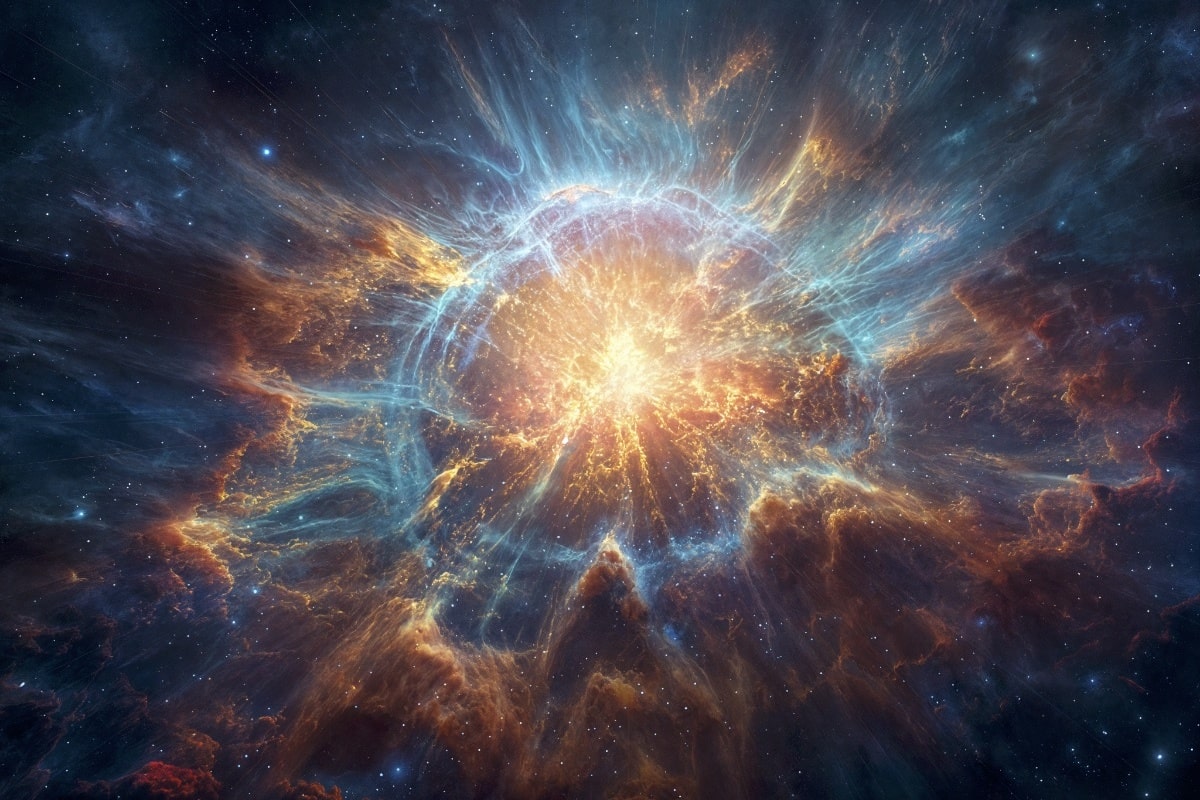
Supernovae are among the brightest and most dramatic phenomena in the Universe, capable of outshining entire galaxies for a short period of time. They mark the spectacular end of a star’s life while simultaneously triggering new cosmic processes. Interesting facts about supernovae help explain the origin of chemical elements, planets, and even the conditions necessary for life. Fascinating and surprising facts about these explosions show how closely destruction and creation are intertwined in space. You may not know that without supernovae, the Universe would look completely different.
- A supernova occurs as a result of a catastrophic explosion of a star at the final stage of its evolution. In an extremely short time, an enormous amount of energy is released. The light from such an event can be visible from millions of light-years away. This is why supernovae play a crucial role in observational astronomy.
- During a supernova explosion, heavy chemical elements are formed. Gold, silver, uranium, and many other elements originate under these extreme conditions. These materials are dispersed into interstellar space. Over time, they become part of new stars, planets, and other cosmic bodies.
- There are several main types of supernovae. Some occur when the core of a massive star collapses under gravity. Others are caused by the explosion of a white dwarf in a binary system. Although the mechanisms differ, the outcome is always an immense release of energy.
- The brightness of a supernova can exceed the brightness of the Sun by billions of times. For several days or weeks, it can shine more brightly than the entire galaxy in which it resides. Gradually, its luminosity begins to fade. These changes are carefully studied using light curves.
- Supernovae strongly influence their surrounding cosmic environment. Shock waves compress interstellar gas and dust. This compression can trigger the formation of new stars. In this way, the death of one star can contribute to the birth of many others.
- After a supernova explosion, a compact object often remains. This remnant may be a neutron star or a black hole. The type of remnant depends on the original mass of the star. These objects represent some of the most extreme states of matter in the Universe.
- In our galaxy, supernovae occur relatively rarely. On average, such explosions happen only a few times per century. Many of them are hidden behind dense clouds of gas and dust. For this reason, astronomers observe the sky across different wavelengths.
- Some supernovae were recorded in ancient times. Historical records from China and other civilizations describe the sudden appearance of very bright stars in the sky. Modern research links these accounts to known supernova remnants. This creates a unique connection between astronomy and human history.
- Type Ia supernovae are especially important for science. They explode with nearly identical maximum brightness. Because of this property, they are used as standard candles to measure cosmic distances. Observations of these events led to the discovery of the accelerated expansion of the Universe.
- A supernova explosion is accompanied by an intense поток of neutrinos. These particles interact very weakly with matter. They reach Earth earlier than the light from the explosion. Detecting neutrinos helps scientists study the internal processes of the blast.
- The temperature in the central regions of a supernova during the explosion can reach billions of degrees. Under such conditions, matter exists in an extremely unusual state. The laws of physics are tested at their limits. This makes supernovae natural laboratories for fundamental research.
- The shock wave from a relatively nearby supernova could potentially affect planetary systems. It may alter atmospheric composition or increase radiation levels. Scientists study possible links between ancient explosions and events in Earth’s history. Such research connects astronomy with geology.
- Supernova remnants have complex and beautiful structures. They appear as expanding nebulae with filaments, shells, and bubbles of gas. These structures preserve information about the explosion itself. Their study can continue for thousands of years after the initial event.
- Supernovae are major sources of cosmic rays. Particles are accelerated to extremely high energies within the shock waves. They then spread throughout the galaxy. Thanks to this process, cosmic rays reach the vicinity of Earth.
- The future of some well-known stars is linked to an eventual supernova explosion. Massive stars in our galaxy are gradually approaching this stage of evolution. Predicting the exact moment of such an event is very difficult. Nevertheless, these explosions will be of enormous importance for scientific observation.
Supernovae clearly demonstrate that the Universe is dynamic and constantly changing. Fascinating facts about these explosions reveal the deep connection between the death of stars and the creation of new cosmic structures. Surprising facts help us realize that many elements of our world have a stellar origin. You may not know that without supernovae, neither planets nor life in its familiar form would exist.


