
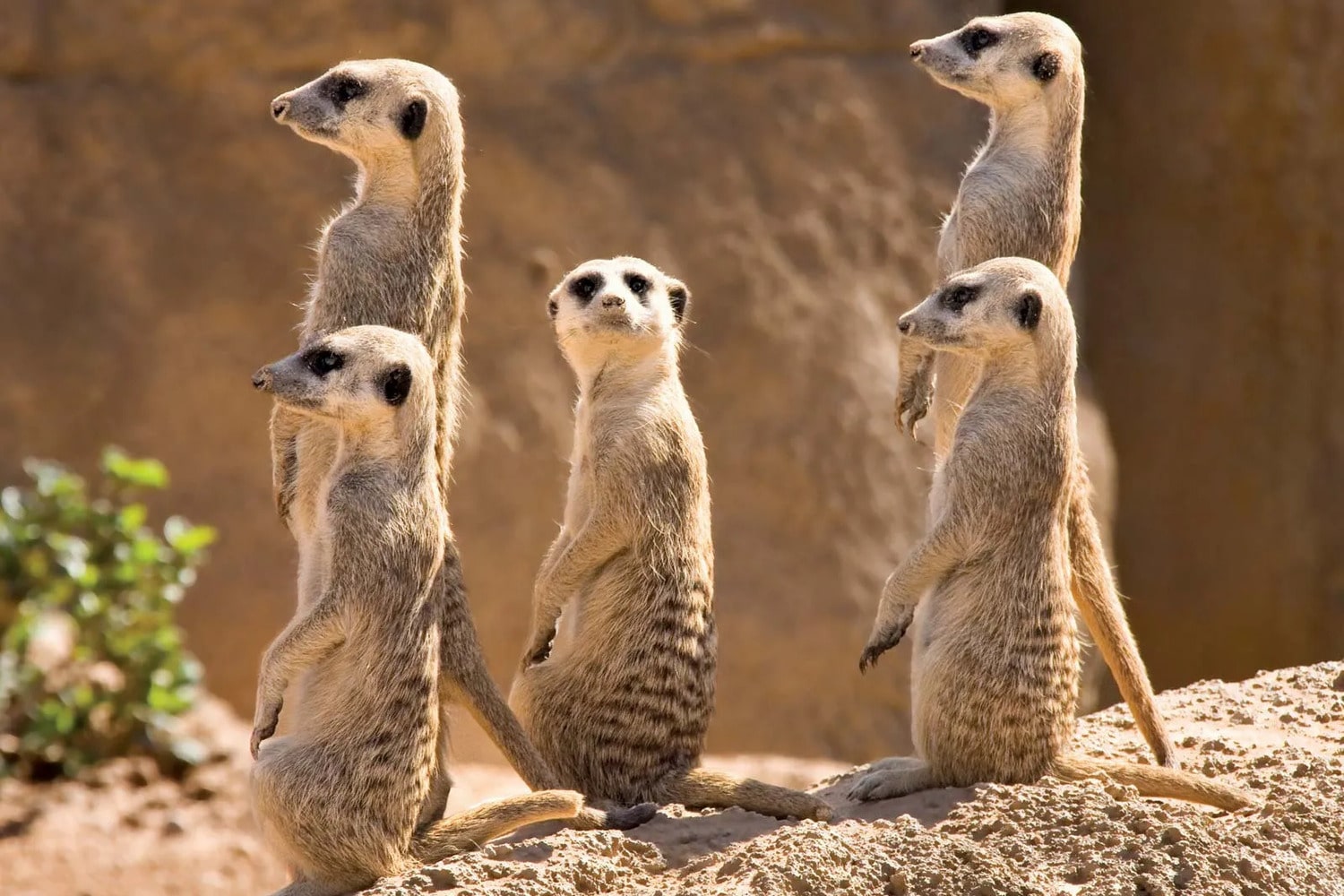
Meerkats are among the most recognizable and charismatic animals of the African continent, known for their habit of standing on their hind legs and vigilantly surveying the horizon. These small mammals from the mongoose family amaze with their complex social structure and collective behavior. Meerkats inhabit the arid regions of Southern Africa and demonstrate remarkable adaptation to the harsh conditions of the desert. Their lives are filled with fascinating features that make them the subject of numerous scientific studies and documentary films. Get acquainted with incredible facts about meerkats that you may not have known about.
- Meerkats belong to the mongoose family and are the smallest representatives of this group with the scientific name Suricata suricatta. Adult individuals weigh from 600 to 900 grams, and their body length ranges from 25 to 35 centimeters without including the tail. The tail of meerkats adds another 17-25 centimeters to the total length and serves for balancing. Males and females look almost identical, although males may be slightly heavier.
- Meerkats inhabit the Kalahari Desert, Namibia, and other arid regions of Southern Africa, including Botswana and parts of Angola. They prefer open spaces with sandy or rocky soil where it is easy to dig burrows. These animals have adapted to life in extremely hot conditions where daytime temperatures can exceed 40 degrees Celsius. They avoid dense forests and areas with high humidity.
- Meerkats live in organized families called mobs or clans that can number from 20 to 50 individuals. Each group has a clear hierarchy with a dominant pair that is usually the only one breeding. All other members of the group help in raising the young, hunting, and guarding the territory. Such cooperative behavior is one of the most developed among mammals.
- In each group of meerkats, sentries are appointed who stand on their hind legs and watch for predators while others feed. Sentries can stand at their post for hours, issuing various sound signals to warn of danger. Different types of alarm signals indicate the type of threat and its location, for example, an aerial predator or a ground predator. When a sentry notices danger, the entire group immediately hides in the nearest burrows.
- Meerkats are insectivorous animals, although their diet also includes small vertebrates, eggs, and plants. They feed predominantly on beetles, spiders, scorpions, centipedes, larvae, and termites. Meerkats have immunity to some venoms, including scorpion venom, which are their favorite food. Before eating a scorpion, they skillfully remove the venomous stinger.
- Meerkat burrows are complex underground systems with numerous tunnels, chambers, and entrances that can cover an area of up to 5 square meters. One group can use several burrow systems on their territory, changing residence every few days. Burrows provide protection from predators and extreme temperatures, maintaining coolness in summer and warmth in winter. Meerkats often occupy abandoned burrows of other animals such as African ground squirrels.
- In the morning, meerkats emerge from their burrows and spend time basking in the sun, standing on their hind legs with raised front paws. This behavior helps them raise their body temperature after a cool night in the burrow. The dark skin on their bellies acts like a solar panel, absorbing heat. They can remain in this position for up to 30 minutes until they warm up sufficiently.
- A female meerkat is pregnant for approximately 11 weeks and usually gives birth to 2 to 5 pups in one litter. The babies are born blind and helpless, weighing only about 25-36 grams. Eyes open approximately 10-14 days after birth. The pups remain in the burrow for the first three weeks of life under the care of babysitters while the mother goes hunting.
- The rearing system in meerkats is truly cooperative, where younger or unpaired members of the group serve as babysitters for the pups. Babysitters remain in the burrow with the babies, protect them from predators, and feed them with milk if they themselves are lactating females. Older meerkats teach the young to hunt, showing how to kill prey and handle scorpions. This learning process can last several weeks.
- Meerkats have dark patches around their eyes that act as natural sunglasses, reducing glare from the bright desert sun. Their vision is very sharp, which allows them to notice predators at great distances. They can see birds in the sky at distances of several hundred meters. Besides vision, meerkats also have excellent smell for detecting food underground.
- The main predators of meerkats are eagles, hawks, jackals, snakes, and other large birds of prey. Due to constant threat from air and ground, meerkats have developed a complex system of communication and defense. When a large snake threatens, the group can unite to scare it away, forming a compact mass and making threatening sounds. Sometimes they even attack small predators as a group.
- Meerkats use more than 20 different types of vocalizations to communicate with each other. These sounds include alarm calls, contact calls, sounds of satisfaction during eating, and aggressive growling. Each type of sound carries specific information about the situation or emotional state of the animal. Pups learn the meaning of these sounds from adult members of the group during the first months of life.
- The lifespan of meerkats in the wild ranges from 5 to 7 years, although in captivity they can live up to 12-14 years. High mortality of young individuals due to predators and harsh environmental conditions lowers the average lifespan. Only about half of the pups survive to adulthood. The dominant female often kills the pups of other females to reduce competition for her own offspring.
- Meerkats have long claws on their front paws that are perfectly adapted for digging and excavating soil in search of food. They can dig a volume of soil equal to their own weight in less than one minute. During digging, meerkats close their ears to prevent sand and dirt from entering. Their eyes also have a special protective membrane for protection from dust.
- The territory of a meerkat group can cover from 5 to 15 square kilometers depending on the availability of food and water. They mark their territory with secretion from scent glands located near the anal opening. Conflicts between different meerkat groups can be very aggressive and even lead to death. These clashes often occur at territory boundaries.
- Meerkats are diurnal animals, which means they are active during the day and sleep at night. Their activity is highest in the morning and evening when temperatures are more moderate. During the hottest midday hours, they often rest in the shade or in burrows. In winter, they may spend more time in the sun to warm up.
- The meerkat population is considered stable, and the species is classified as of least concern according to the International Union for Conservation of Nature classification. However, they face threats from habitat loss due to the expansion of agriculture and cities. In some regions, meerkats are also persecuted by farmers who consider them pests. Ecotourism helps protect meerkat populations by making them valuable to local communities.
Meerkats continue to captivate scientists and wildlife enthusiasts with their complex social behavior and adaptations. Interesting facts about these small desert dwellers demonstrate how amazingly nature has created survival mechanisms in extreme conditions. The study of meerkats reveals incredible aspects of cooperation, communication, and family bonds in the animal world. These charming creatures remind us of the importance of cooperation and mutual assistance for survival in a complex world.


