
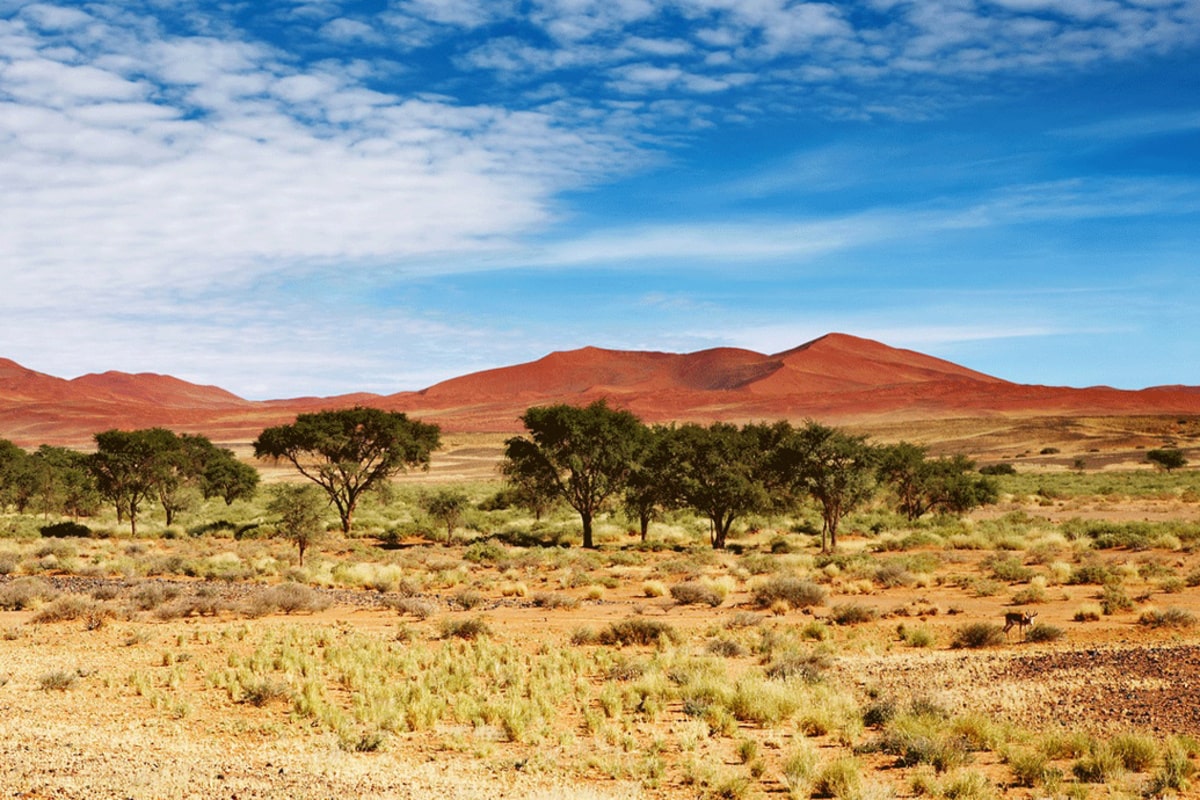
The Kalahari Desert is one of the most mysterious and least explored regions of southern Africa. It stretches across several countries and impresses with its harsh climate, rich biodiversity, and ancient human history. While the word “desert” often brings to mind images of lifeless, barren landscapes, the Kalahari defies this stereotype. This region is home to water sources, wildlife, seasonal lakes, and Indigenous communities that have adapted to its extreme conditions over thousands of years. Below are some interesting facts about the Kalahari that you might not have known.
- The Kalahari Desert covers an area of approximately 900,000 square kilometers. It spans Botswana, Namibia, and South Africa. Parts of it also reach into Zimbabwe, Zambia, and Angola. This makes it one of the largest semi-arid regions on the planet.
- Despite its name, the Kalahari is not a true desert in the strict geographical sense. It receives far more rainfall than classic deserts such as the Sahara. In some areas, annual rainfall can reach up to 500 millimeters. This allows for the presence of diverse plant and animal life.
- The name “Kalahari” comes from the Tswana word “Kgalagadi,” which means “great thirst” or “land without water.” This reflects the difficulty of surviving in such an environment. Although there are seasonal rains, droughts can last for many months. Local people have developed techniques to use water with extreme efficiency.
- The Kalahari is home to one of the oldest Indigenous peoples in the world — the San people, also known as Bushmen. They possess deep knowledge of the environment, medicinal plants, animal behavior, and survival strategies. Their language includes unique clicking sounds that are difficult for outsiders to reproduce. Some San communities still maintain a traditional lifestyle.
- At the center of the Kalahari lies the Central Kalahari Game Reserve, the second-largest protected area in the world. It covers more than 52,000 square kilometers. The reserve was established to protect local ecosystems and support the San people’s cultural heritage. Visitors come to admire the wildlife and untouched landscapes.
- The sand in the Kalahari is a striking reddish-orange color due to a high concentration of iron oxides. This gives the landscape a vivid hue, especially during sunrise and sunset. The fine sand retains heat for long periods, influencing the microclimate of the region. This, in turn, affects vegetation and animal activity.
- Despite being arid, the Kalahari supports a wide range of animals adapted to scarce water conditions. Lions, cheetahs, hyenas, antelope, ostriches, and many smaller mammals and birds live here. Some species can survive without drinking water by extracting moisture from food. Evolution has created some of the toughest creatures in this environment.
- During the rainy season, temporary lakes and wetlands appear across the Kalahari. One example is Makgadikgadi, a seasonal lake that is the remnant of a prehistoric inland sea. When flooded, it attracts thousands of flamingos, creating stunning visual spectacles. These events last only a few weeks each year.
- The region is home to many unique plants that thrive in extreme drought. For example, the camel thorn tree has deep roots that tap underground water sources. Many plants have thick leaves or spines to minimize water loss. Some remain dormant most of the year and bloom only after rainfall.
- Although the desert may seem quiet, the Kalahari is full of sounds. At night, one can hear jackals howling, nocturnal birds calling, the rustling of small animals, and the chatter of meerkats. Meerkats are among the most iconic inhabitants of the region. They live in colonies with complex social structures and teach their young through vocal communication and example.
- Fossils found in parts of the Kalahari indicate that the area once had a much wetter climate. Remains of hippos, crocodiles, and other animals have been discovered in ancient sediment layers. These findings show that the desert has undergone dramatic climate changes over millennia. Researchers continue to study these transformations today.
- One of the most unusual natural sights in the Kalahari is the presence of “dancing trees.” These trees have twisted trunks and branches shaped by wind and water scarcity. They resemble abstract sculptures and attract the attention of artists and photographers. They add a surreal beauty to the desert landscape.
- Temperature fluctuations in the Kalahari can be extreme, ranging from +45°C during the day to near freezing at night. This creates challenges for all forms of life. Most animals are active only during the cooler hours of morning and evening. Humans also adjust their routines based on the time of day.
- In some parts of the Kalahari, natural acoustics allow sound to travel great distances. This helps animals and people navigate the open terrain. Locals have used echoes to communicate across long distances. Such natural signaling methods have been passed down for generations.
These fascinating facts about the Kalahari reveal that even the harshest landscapes can be full of life, history, and mystery. The desert follows its own rules and holds ancient stories, biological wonders, and cultural depth waiting to be explored. You might not have known that the Kalahari is much more than just sand — it is a vast living world filled with adaptation, survival, and beauty. It remains one of the most captivating and inspiring places on Earth.


