
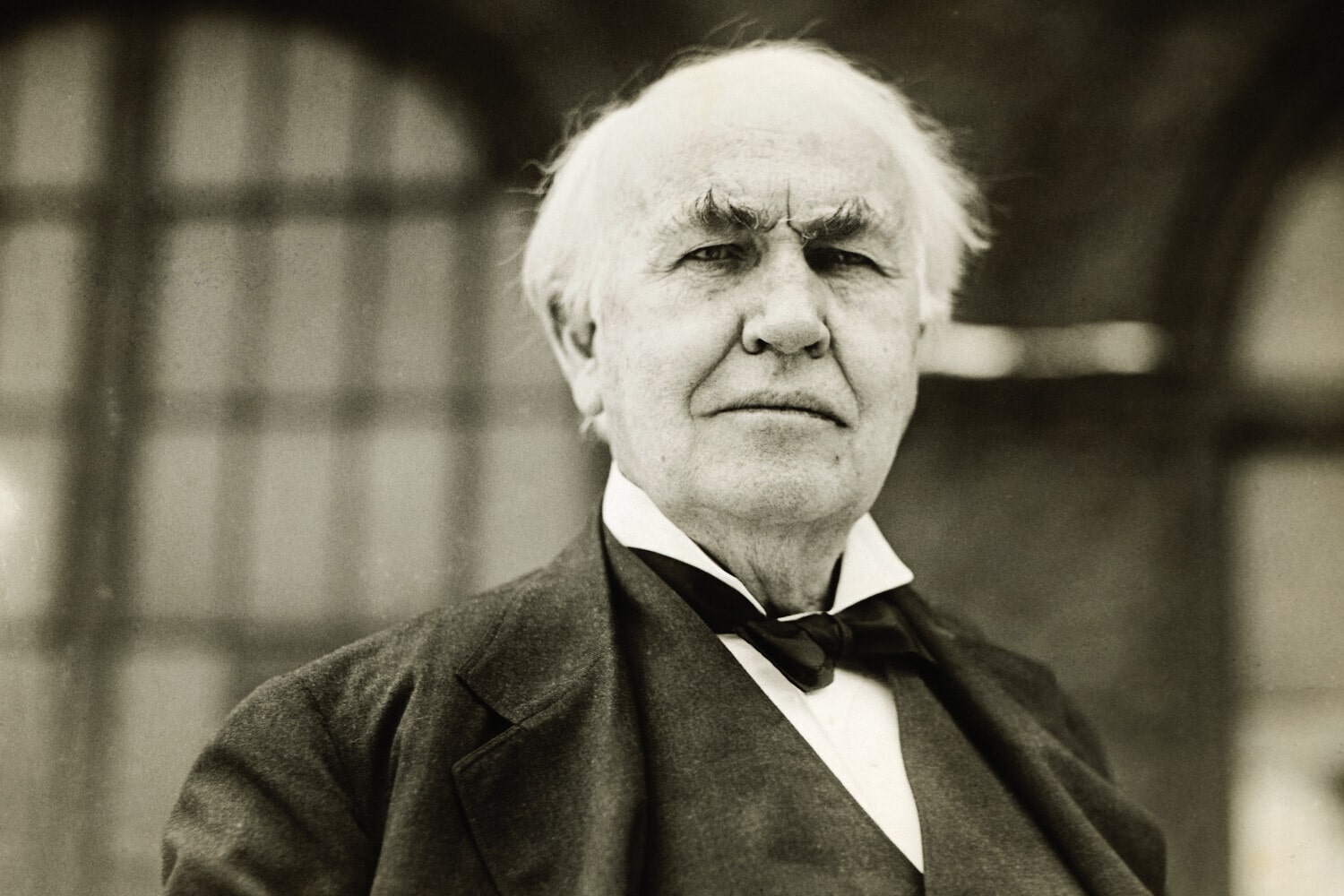
Thomas Edison is considered one of the greatest inventors in human history, and his name is forever associated with an era of rapid technological progress. He became a symbol of perseverance, engineering ingenuity and the ability to turn bold ideas into practical solutions. Edison was known not only for his inventions but also for his remarkable way of thinking, which allowed him to see opportunity where others saw obstacles. His biography contains many incredible and little-known details that you may not have known before. Below are fascinating facts about Thomas Edison that reveal the scale of his influence on science and technology.
- Thomas Edison was born in 1847 in Milan, Ohio, and was the youngest child in his family. As a child he partially lost his hearing, which many researchers believe strengthened his focus and inclination for solitary work. He read extensively and showed early interest in physics and mechanics. This curiosity laid the foundation for his future experiments.
- Edison received very little formal education and studied mostly at home. His mother, a former teacher, personally taught him the basics of science and literature. She encouraged his love of reading and independent learning. Thanks to her influence, Edison developed his own method of continuous self-education.
- As a teenager Edison worked as a telegraph operator, and this job strongly shaped his technical abilities. He studied telegraph systems, experimented with signal transmission and explored ways to improve equipment. The experience gave him essential knowledge of electricity. Telegraphy became his first pathway into the world of engineering innovation.
- Edison achieved his first major success after inventing an improved telegraph device that could send multiple messages over a single wire. This innovation greatly increased communication efficiency and attracted investor interest. With these funds Edison was able to open his own laboratory. From that moment he fully dedicated himself to research.
- In 1877 Edison invented the phonograph, a device capable of recording and playing back sound. This discovery astonished the public, as no one before him had achieved anything similar. The phonograph brought him worldwide fame. Edison often said it was his favourite invention of all.
- Edison became widely known for perfecting the incandescent light bulb. Although he did not create the first bulb, he made it practical, durable and suitable for mass production. He tested thousands of materials before finding the right filament. His persistence paved the way for global electrification.
- The inventor created the world’s first power station that supplied electricity to homes and streets. It opened on Pearl Street in New York City and marked a breakthrough in the history of energy. The station produced direct current and demonstrated the potential of centralised electric supply. It signalled the beginning of a new technological era.
- Throughout his life Thomas Edison obtained more than a thousand patents in various scientific fields. His inventions spanned electricity, telegraphy, acoustics, chemistry and even early cinematography. The sheer number of patents shows his extraordinary productivity and wide range of interests. He constantly searched for new ideas and never stopped experimenting.
- Edison played a crucial role in the development of the film industry, creating devices such as the kinetophone and kinetoscope. These machines allowed the viewing of moving images and became the predecessors of modern cinema. He also contributed to establishing the first film studios. His work laid the groundwork for the rise of mass cinematography.
- Edison’s laboratory in Menlo Park became one of the first research and development centres in the world. A team of specialists worked there, helping him carry out ambitious experiments. Many groundbreaking innovations were created at this site, redefining technological progress for future generations. Menlo Park is often called the birthplace of modern research laboratories.
- Edison followed an extremely demanding work schedule, sometimes working up to eighteen or twenty hours per day. He believed that success depended on persistence and discipline rather than innate talent. He slept in short intervals to avoid wasting time. His work ethic impressed and surprised many contemporaries.
- Failures never discouraged Edison; instead they motivated him. He viewed mistakes as an essential part of the creative process and insisted that each failed experiment brought him closer to the right solution. His optimism encouraged his team to continue their efforts. This ability to learn from failure was one of the secrets of his success.
- Despite his intense workload Edison maintained an interest in nature, music and reading. He enjoyed experimenting with sound and created various musical devices. He closely followed scientific discoveries made by other researchers. His worldview was shaped by a broad spectrum of knowledge.
- Edison had a complex personality and frequently clashed with other inventors. His rivalry with Nikola Tesla is one of the most famous in scientific history. They held different opinions on the use of electricity and competed for technological leadership. Their conflict had a lasting impact on the development of electrical engineering.
- In the final years of his life Edison continued to experiment with new materials and mechanical devices. He studied the properties of natural rubber and searched for ways to improve its production. Even at an advanced age he remained curious and full of ideas. His dedication earned admiration from those around him.
These interesting facts about Thomas Edison show how vast his contributions were and how significantly he influenced scientific and technological progress. Such remarkable information helps us better appreciate the inventor’s talent, determination and ability to reshape the world through creativity. These captivating facts demonstrate that Edison was not only an inventor but a true pioneer whose legacy continues to inspire researchers and creators across the globe.


