
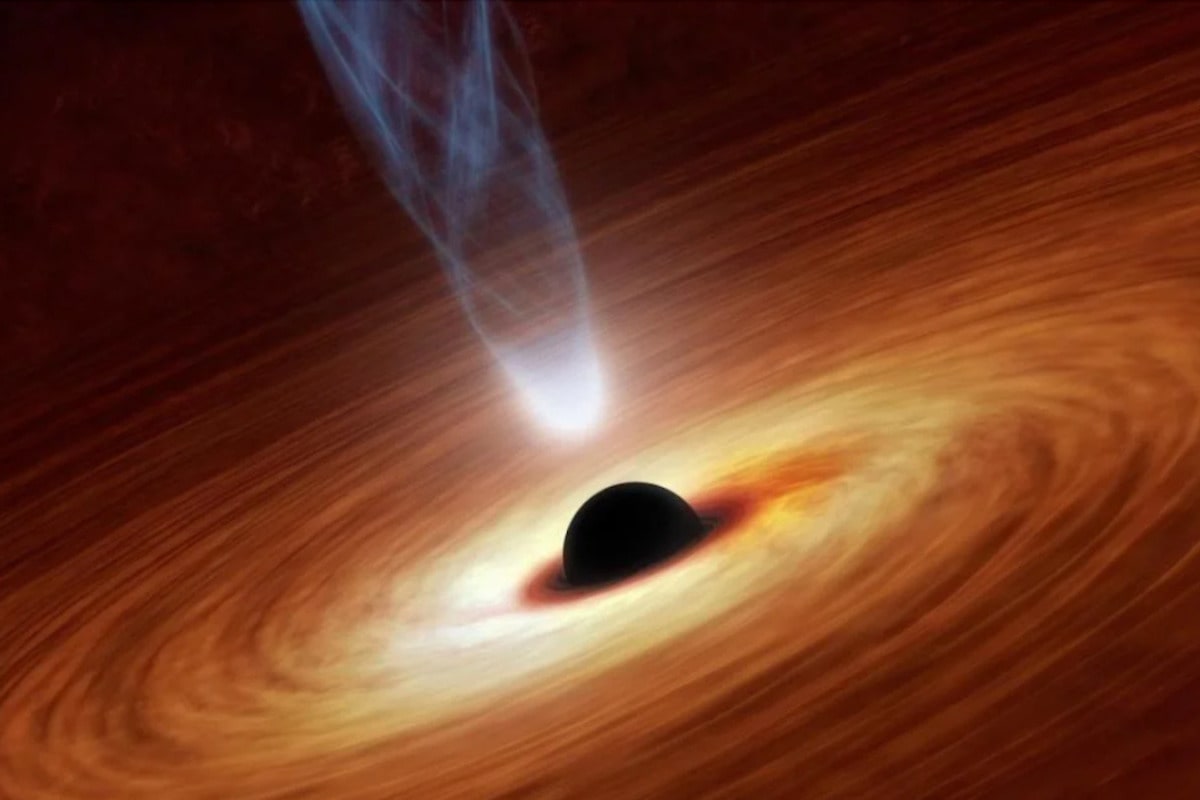
Black holes are among the most mysterious and astonishing objects in the Universe, and their extraordinary properties have fascinated scientists for decades. You might not know that their behaviour goes far beyond what is familiar from classical physics, as black holes challenge many intuitive principles. These captivating and surprising facts help reveal the nature of the cosmos and the processes that shape it. Exploring black holes offers an entirely new perspective on space, time and matter. The world of these objects is full of secrets that science is still striving to understand.
- Black holes form when massive stars explode as supernovae and their cores collapse into an extremely dense state. This collapse is so intense that no known force can stop it. Even atoms lose their internal structure under such pressure. As a result, an object with nearly infinite density emerges.
- The most important feature of a black hole is the event horizon, which marks a boundary beyond which nothing can return. Once light or any object crosses this boundary, it disappears inside the black hole forever. The event horizon is not a physical surface but rather a conceptual point of no return. This makes black holes unique among cosmic objects.
- A black hole is not empty space, but a region filled with ultra-dense matter compressed into a tiny volume. This zone is known as the singularity, where familiar physical laws cease to function. Scientists still struggle to understand the true nature of singularities. They remain one of the most perplexing topics in modern astrophysics.
- Black holes can grow by absorbing gas, dust, stars and other surrounding objects. As matter falls into a black hole, it heats up enormously and emits X-rays. Telescopes detect this radiation, allowing astronomers to identify black holes even though they are themselves invisible. This indirect observation provides crucial information about their activity.
- There are supermassive black holes whose masses reach millions or even billions of times the mass of the Sun. They are located at the centres of most galaxies, including our Milky Way. Such objects have a profound influence on the formation and evolution of galaxies. Their gravitational impact shapes large-scale cosmic structures.
- At the centre of our galaxy lies a supermassive black hole known as Sagittarius A*, which has a mass of about four million Suns. It is located roughly twenty-six thousand light-years from Earth. Despite its enormous size, it poses no threat to our planet because of the vast distance separating us. Sagittarius A* is one of the most studied objects in contemporary astronomy.
- Black holes cannot move freely at random, but they can shift due to gravitational interactions. When two black holes draw close to each other, they may merge, forming a new one and releasing gravitational waves. These waves were first detected in the twenty-first century. This discovery marked a major milestone in astrophysical research.
- Some black holes rotate at extremely high speeds, sometimes close to the speed of light. This rotation distorts the surrounding space and alters the paths of nearby objects. The phenomenon is known as frame dragging. It reveals the complex nature of gravity in extreme environments.
- There is a theoretical idea that black holes slowly lose mass through a process called Hawking radiation. This radiation causes black holes to evaporate over incredibly long periods of time. For large black holes, this process can take trillions of years. It shows that black holes are not completely eternal.
- The smallest hypothetical black holes might have masses comparable to that of a mountain while being smaller than an atom. These micro black holes are still theoretical, but some models suggest they could have formed shortly after the Big Bang. Their discovery would revolutionise modern physics. They remain an intriguing possibility for researchers.
- Black holes often have accretion disks composed of hot, rapidly rotating matter. These disks shine brighter than many stars because of their extreme temperatures. Telescopes observing this radiation help scientists study the physics near black holes. Accretion processes reveal many details about extreme cosmic environments.
- Black holes influence the motion of stars in their galaxies by keeping them in stable orbits. They act as gravitational anchors around which stellar systems organise themselves. This allows galaxies to maintain their structure over billions of years. Without black holes, cosmic architecture would look completely different.
- Some black holes emit powerful relativistic jets composed of particles travelling enormous distances. These jets can stretch across entire galaxies and move at speeds close to that of light. They form immense energy fields that affect interstellar space. Such phenomena are among the most spectacular in cosmology.
- Black holes often exist in binary systems alongside stars. When a star loses part of its mass, the black hole may capture this material, causing bright X-ray flares. Astronomers use these flares to detect invisible black holes. Such systems serve as natural laboratories for studying extreme conditions.
These interesting facts about black holes show how complex and multidimensional the Universe truly is. You might not know how significant a role these mysterious objects play in shaping galaxies and cosmic structures. Black holes remain one of the most enigmatic subjects in science, continually offering new directions for exploration. Studying them helps deepen our understanding of the nature of space, time and matter.


