
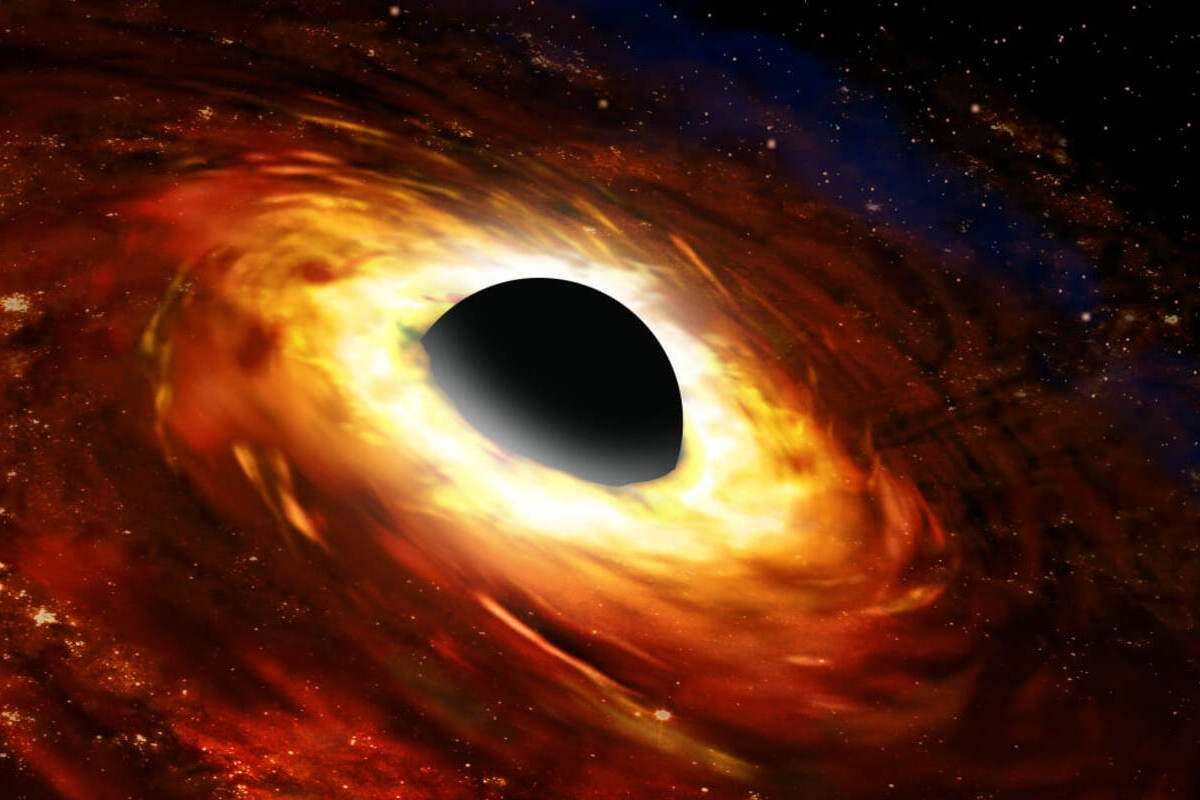
Accretion disks are among the most mysterious and fascinating structures in the Universe, yet many people know very little about their true nature. They form under the most extreme cosmic conditions and allow astronomers to study processes that shape galaxies, stars and black holes. In this article you will find interesting facts you may not have known, offering a fresh perspective on the physics and evolution of accretion disks. These disks play a crucial role in the development of many celestial objects, and their study helps reveal the earliest stages of cosmic history. These captivating facts open a window into a world of extreme energies and phenomena far beyond anything found on Earth.
- Accretion disks form around massive objects that pull in surrounding material. Gas, dust and plasma rotate around the central body and gradually fall inward under the force of gravity. Such structures appear around black holes, neutron stars, white dwarfs and young protostars. They are an essential component of many astrophysical systems.
- The temperature within an accretion disk increases dramatically closer to the center. Inner layers can reach millions of degrees due to intense friction between particles. As a result, the disk emits X-ray radiation detected by space telescopes. This emission has led to the discovery of numerous black holes.
- Accretion disks surrounding black holes exist in regions where gravity is so strong that time itself slows down. Light escaping from the inner zones experiences gravitational redshift. This effect enables scientists to measure the mass and spin of black holes. Such observations became possible only with the advances of modern astrophysics.
- Particles in accretion disks can reach velocities close to the speed of light. This makes the disks some of the most energetic structures in the Universe. They generate immense flows of energy that influence their cosmic environments. Conditions like these cannot be reproduced in laboratories on Earth.
- Accretion disks can persist for millions of years, yet their structure constantly changes. Turbulence, density waves and instabilities disturb the equilibrium within the disk. Each disk follows a unique evolutionary path. Studying these variations helps scientists understand the physics of extreme environments.
- Powerful particle jets form at the centers of some accretion disks. These jets shoot out in opposite directions and can stretch for thousands of light years, carrying tremendous amounts of energy. They arise from complex interactions between magnetic fields and rapid rotation of the central object. Jets are among the most spectacular phenomena in the cosmos.
- Accretion disks play a fundamental role in the formation of planetary systems. Young stars are surrounded by protostellar disks where dust particles collide and merge, forming planetesimals. Over time these structures evolve into planets, asteroids and comets. Accretion is therefore the foundation of planetary birth.
- Some massive accretion disks become so large that their own gravity reshapes their structure. Spiral waves can form inside the disk, resembling the arms of spiral galaxies. These waves help move material toward the center. Through this process the disk continuously reorganizes itself.
- Accretion disks around white dwarfs can trigger nova events, when a sudden brightening of the star occurs. Incoming matter ignites thermonuclear reactions on the surface of the white dwarf. This causes a temporary but dramatic increase in brightness. Such events allow scientists to study accretion on smaller scales.
- Disks around neutron stars can produce quasi-periodic oscillations — rapid, repeating variations in X-ray emissions. These oscillations reveal the physical properties of neutron stars. Because such stars possess extreme density and powerful magnetic fields, their disks are highly valuable for scientific research. They offer a rare view into matter under extreme pressure.
- Accretion disks in galactic centers feed supermassive black holes. When the inflow of material becomes too high, the disk becomes unstable and forms intensely bright active galactic nuclei. These objects can be seen from billions of light years away. They are among the strongest sources of radiation in the Universe.
- In some accretion disks strong winds push matter outward into space. These winds can influence the formation of nearby stars and shape the interstellar medium. They also remove angular momentum, slowing the inward fall of material. This creates a delicate balance between gravity and internal pressure.
- Accretion disks act as natural laboratories for studying matter under powerful gravitational fields. Their radiation allows scientists to test predictions of general relativity. These structures provide insight into physics under conditions unattainable on Earth. Even from great distances they offer valuable information about cosmic processes.
- Turbulence within accretion disks transports material from the outer layers toward the inner regions. Scientists attribute this process to magneto-rotational instability. It ensures an efficient transfer of energy and angular momentum. Without this mechanism accretion would proceed far more slowly.
These interesting facts about accretion disks highlight their importance for understanding the structure and evolution of the Universe. You may not have known that accretion processes accompany the birth of stars, feed black holes and shape planetary systems. Research on these disks opens the door to exploring the most extreme cosmic phenomena. They remain some of the most captivating and informative objects in modern astronomy.


