
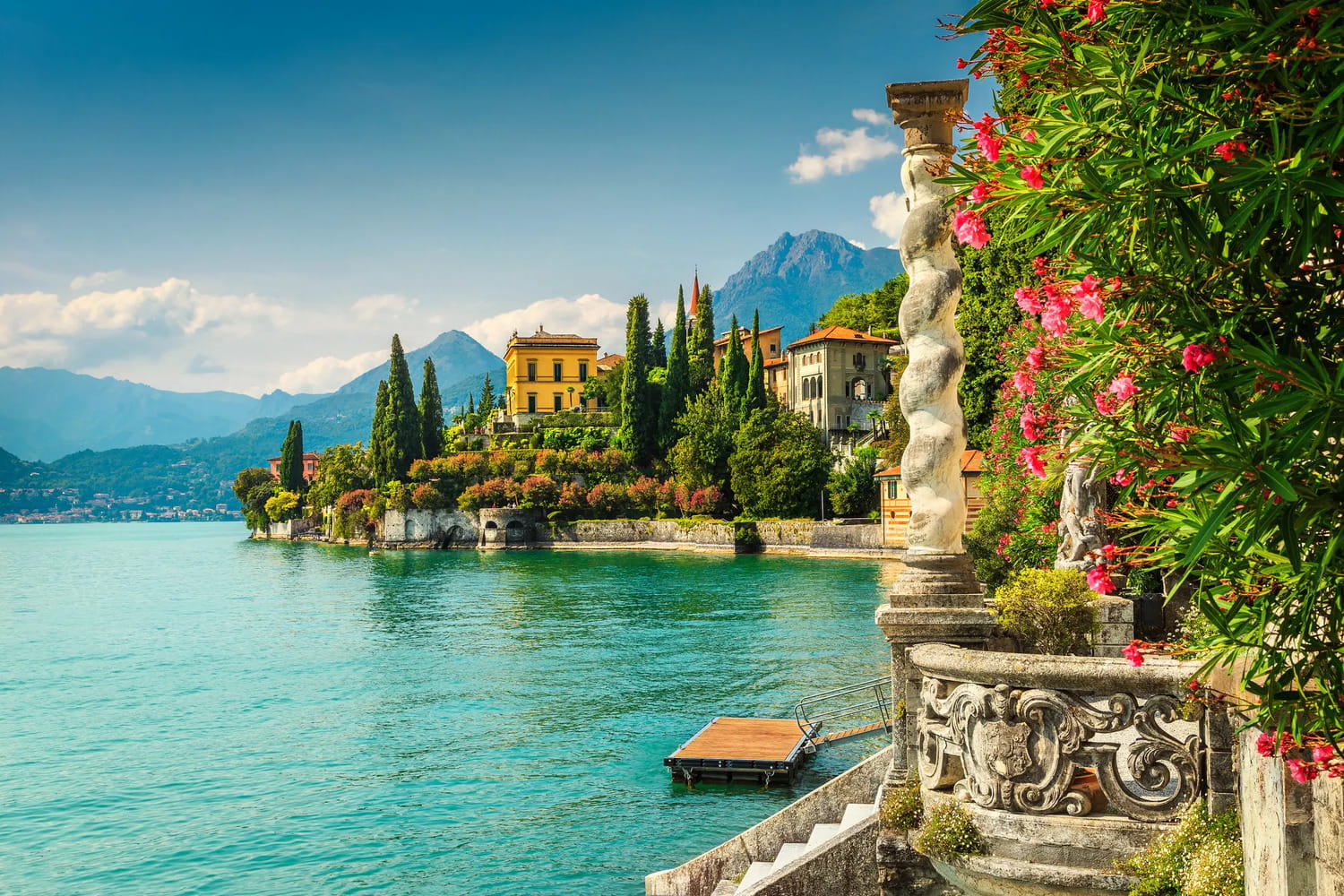
Italy is a country that seems to have been created to astonish: at every step one senses the breath of millennia, and art, architecture, and cuisine have reached such a level of perfection that the rest of the world continues to learn from them to this day. This nation gifted humanity the Roman Empire, the Renaissance, opera, pizza, and a countless multitude of geniuses whose names every schoolchild knows. Fascinating facts about Italy can be discovered literally on every street, in every museum, and at every café table where a genuine espresso is served. This country is so saturated with history, art, and culture that even the local residents are sometimes unaware of the treasures hidden right beside them. We present a collection of interesting facts about Italy that you may never have known.
- Italy is the world leader in terms of the number of UNESCO World Heritage Sites — as of today there are 58 of them, which is an absolute record among all the countries of the world. Among them are the Colosseum, Pompeii, the historic centres of Florence, Venice, Rome, and Naples, as well as nature reserves and even individual industrial complexes. Such a concentration of remarkable places within a comparatively small territory is without precedent anywhere in the world.
- On the territory of Italy there are two independent states — Vatican City and San Marino — which is a unique phenomenon for any country in the world. Vatican City, with an area of 0.44 square kilometres, is the smallest state in the world and at the same time the centre of Catholicism for more than one billion believers. San Marino lays claim to the title of the oldest republic in the world — it was founded as far back as 301 AD.
- Rome is often called the Eternal City, and this name is entirely justified — the city has been continuously inhabited for more than 2,800 years. According to legend, Rome was founded in 753 BC by the twin brothers Romulus and Remus, who were suckled by a she-wolf. Today, in the very heart of a modern metropolis, one can encounter ruins more than 2,000 years old that are organically woven into the fabric of the city’s everyday life.
- The Colosseum in Rome, built between 70 and 80 AD, is the largest amphitheatre ever constructed in the world and could accommodate between 50,000 and 80,000 spectators simultaneously. Beneath the arena of the Colosseum there existed a complex system of underground tunnels and chambers from which gladiators, animals, and stage sets were raised to the arena by means of lifts. Despite the fact that the structure has survived earthquakes, looting, and two millennia, it continues to impress with its scale to this day.
- The Leaning Tower of Pisa tilted not because of an architect’s error but on account of the soft ground on one side of the foundation, which began to subside during construction in 1173. Today the tower’s lean stands at approximately four degrees following stabilisation works carried out in the late 1990s and early 2000s that saved the structure from complete collapse. The irony of fate lies in the fact that it was precisely this defect that made the tower world-famous and attracts millions of tourists to it every year.
- Venice is built upon 118 small islands connected to one another by more than 400 bridges and separated by 150 canals. The city was constructed from the fifth century AD onwards on wooden piles driven into the muddy bed of the lagoon, and to this day it rests upon millions of these wooden supports. Every year Venice sinks into the water by approximately one to two millimetres, and scientists are seriously discussing scenarios for saving the city from rising sea levels.
- Pompeii — the ancient Roman city destroyed by the eruption of Mount Vesuvius in 79 AD — is one of the most important archaeological sites in the world. The volcanic ash preserved the city so perfectly that archaeologists find here not only buildings and everyday objects but also food remains, graffiti on walls, and even casts of the bodies of people who perished. Excavations at Pompeii continue to this day and regularly yield new sensational discoveries.
- Florence is universally recognised as the cradle of the Renaissance — the cultural and artistic revolution that transformed all of European civilisation between the fourteenth and seventeenth centuries. It was here that Leonardo da Vinci, Michelangelo, Botticelli, and Dante Alighieri created their works, and it was here that the Medici family financed art and science with unprecedented generosity. The Uffizi Gallery in Florence holds one of the largest collections of Renaissance art in the world.
- Michelangelo painted the ceiling of the Sistine Chapel in the Vatican over four years — from 1508 to 1512 — and carried out this work almost entirely alone. Contrary to the popular myth, he painted not lying on his back but standing on specially constructed scaffolding with his head thrown back, which led to serious health problems. The surface area of the painting exceeds 500 square metres and contains more than 300 figures.
- Leonardo da Vinci — a native of the small Tuscan town of Vinci — is perhaps the most universally gifted genius in the history of humanity. He was simultaneously a painter, sculptor, architect, musician, mathematician, engineer, inventor, anatomist, geologist, and botanist. Among his inventions were prototypes of the helicopter, the tank, the solar collector, and the large telescope, all of which were several hundred years ahead of their time.
- Italy is the birthplace of opera — the musical genre that arose in Florence at the end of the sixteenth and the beginning of the seventeenth century. The first operas were created as an attempt to recreate ancient Greek theatre and were initially performed exclusively for aristocratic audiences. Today Milan is one of the world’s opera capitals thanks to the Teatro alla Scala, founded in 1778 and still considered one of the most prestigious opera venues in the world.
- Pizza originated in Naples in the eighteenth and nineteenth centuries as food for the poor — a simple, cheap, and filling dish for the urban poor. Today the Pizza Napoletana has been inscribed on the UNESCO list of the Intangible Cultural Heritage of Humanity, and Naples takes pride in its distinctive style of pizza-making with soft and elastic dough. Approximately 5 billion pizzas are eaten around the world every year, and most recipes trace their roots in one way or another to Neapolitan traditions.
- Cuisine is a genuine cult in Italy — more than 400 different types of pasta are counted here, and every region takes pride in its own unique recipes. Bologna lays claim to the birthplace of Bolognese sauce, Rome to carbonara and cacio e pepe, and Genoa to pesto sauce. Even within a single region, neighbouring towns may argue over the correct way of preparing one and the same dish.
- Espresso in Italy is not merely a beverage but an entire philosophy and a social ritual. According to the unwritten code of a true barista, espresso is served in a warmed cup, drunk standing at the bar counter, and costs a fixed sum that has remained virtually unchanged for decades. Cappuccino, by strict Italian convention, may only be consumed in the morning — ordering a cappuccino after eleven o’clock in the morning will immediately identify you as a foreigner.
- Italy is one of the oldest fashion capitals in the world, and the cities of Milan, Florence, and Rome traditionally rank among the arbiters of global fashion. Brands such as Gucci, Prada, Versace, Armani, Fendi, and Dolce & Gabbana were born here, transforming Italy into a synonym for elegance and style. Milan Fashion Week is one of the four most prestigious in the world, alongside Paris, London, and New York.
- The Italian automotive industry has given the world such legendary brands as Ferrari, Lamborghini, Maserati, Alfa Romeo, and Fiat. Ferrari, founded by Enzo Ferrari in 1939 in Maranello, is perhaps the most prestigious automotive brand in the world and never produces more cars than there is demand for them. The legend that Lamborghini came into existence because Ferruccio Lamborghini quarrelled with Enzo Ferrari over a clutch pedal is one of the best-known anecdotes in automotive history.
- Mount Vesuvius near Naples is the only active volcano on the European mainland and is considered one of the most dangerous volcanoes in the world. Approximately 3 million people live within the potential danger zone of the volcano, making this area one of the most vulnerable in the world from the standpoint of volcanic risk. The last significant eruption of Vesuvius occurred in 1944 during the Second World War.
- Italy has the greatest number of thermal springs in Europe — more than 380 resorts with natural hot springs are scattered throughout the country. The tradition of taking the waters — balneology — dates back to the times of ancient Rome, when thermal baths were an integral part of public life. Today thermal tourism is one of the most profitable sectors of the Italian tourist industry.
- The Voynich Manuscript — the most mysterious book in the world, written in an unknown language and still undeciphered — is held in the library of Yale University, but its most likely place of origin is considered to be northern Italy of the fifteenth and sixteenth centuries. The book contains drawings of unknown plants, astronomical diagrams, and depictions of naked female figures bathing in green liquids. Despite the efforts of the finest cryptographers, linguists, and even artificial intelligence, the secret of the manuscript remains unsolved to this day.
- Italy has more than 1,500 lakes, and most of them are located in the north of the country in the region of the Alps and the foothills. Lake Como, a favourite holiday destination for world celebrities, is one of the deepest in Europe — its depth reaches 425 metres. Lake Garda is the largest lake in Italy and every year attracts millions of tourists with its mild microclimate and picturesque shores.
- Ancient Rome gifted the modern world an extraordinary number of things, including the legal system, the concepts of republic and democracy, concrete, central heating, newspapers, public baths, and a postal service. The Latin language spoken by the Romans became the foundation for all the Romance languages — Italian, Spanish, French, Portuguese, and Romanian. Without the legacy of ancient Rome, modern Western civilisation would look entirely different.
Italy is a country that cannot be exhausted by any number of visits, for every region, every city, and even every small town possesses its own unique soul and incomparable history. Every incredible fact about this country is merely a tiny window into the boundless world of Italian civilisation, which has shaped humanity over the course of millennia. This nation continues to astonish — and it is precisely for this reason that Italy remains one of the most coveted destinations for travellers from around the world, year after year opening before them new horizons of beauty and discovery.


